Details
Artist
Styles
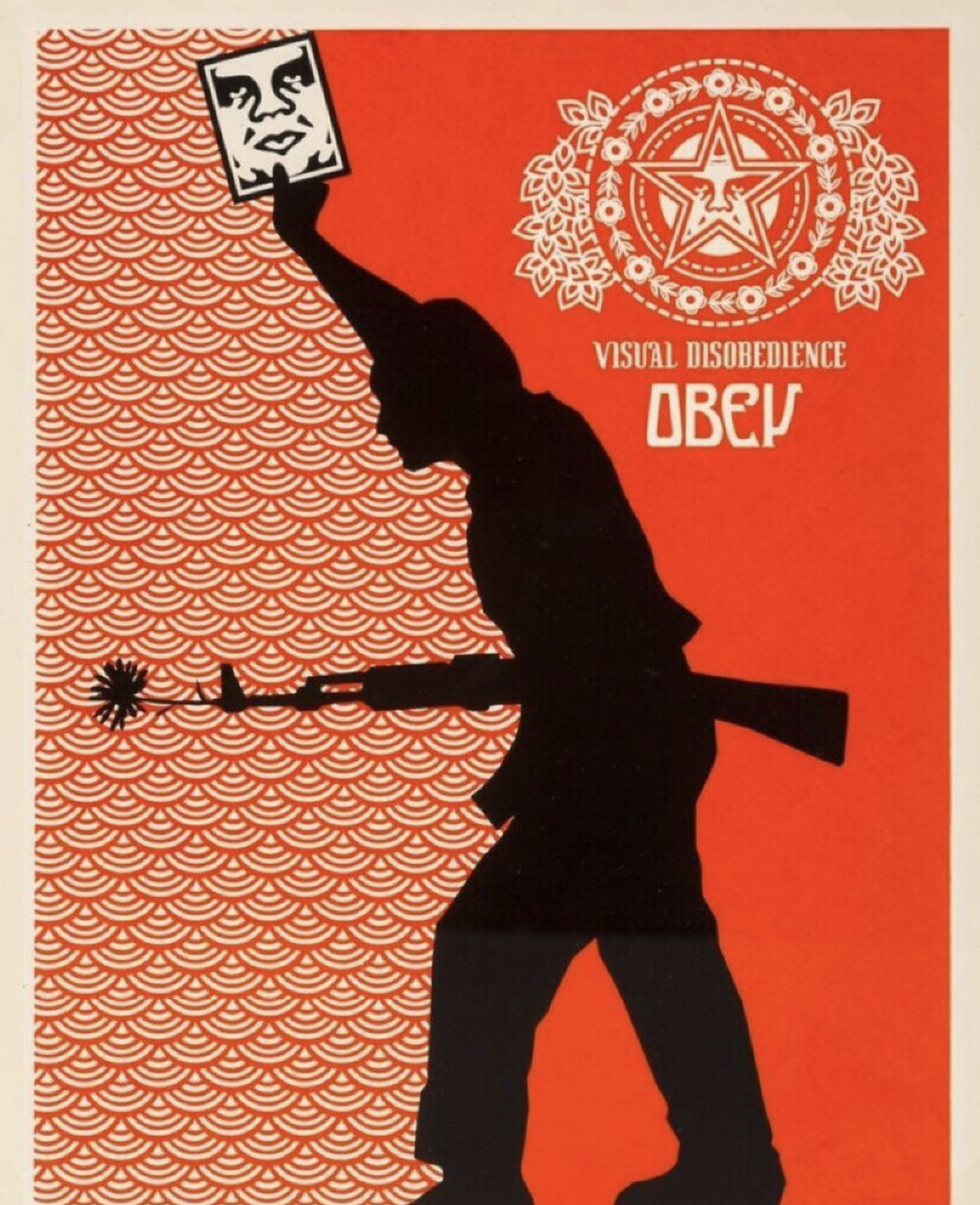
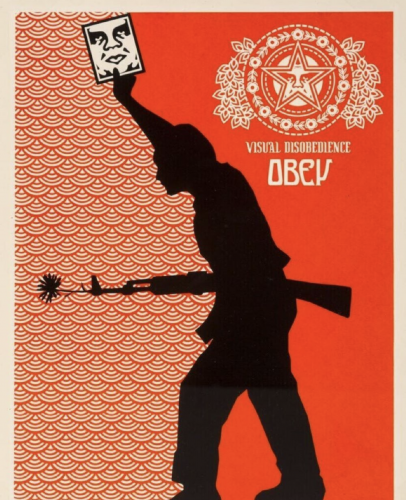
Visual Disobedience by Shepard Fairey, created in 2004, is a bold screenprint exploring the subversive power of visual culture. A black silhouette of a militant figure dominates the composition, holding a rifle that blossoms into a flower while triumphantly raising an Obey icon. The red background, overlaid with patterned waves and Fairey’s signature star emblem, evokes revolutionary posters while critiquing propaganda. With the phrase "Visual Disobedience" stamped beside the star, the artwork proposes imagery as a weapon for ideological resistance. This piece was produced in an edition of 333.
Visual Disobedience, 2004
form
Medium
Size
61 x 45.7 cm
- Inches
- Centimeters
Edition
Price
- USD
- EUR
- GBP
Details
Artist
Styles
Visual Disobedience by Shepard Fairey, created in 2004, is a bold screenprint exploring the subversive power of visual culture. A black silhouette of a militant figure dominates the composition, holding a rifle that blossoms into a flower while triumphantly raising an Obey icon. The red background, overlaid with patterned waves and Fairey’s signature star emblem, evokes revolutionary posters while critiquing propaganda. With the phrase "Visual Disobedience" stamped beside the star, the artwork proposes imagery as a weapon for ideological resistance. This piece was produced in an edition of 333.
- Recently Added
- Price (low-high )
- Price (high-low )
- Year (low-high )
- Year (high-low )
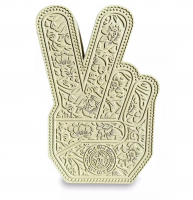
Shepard Fairey
Peace Fingers, 2023
Sculpture / Object
Resin
GBP 2,590
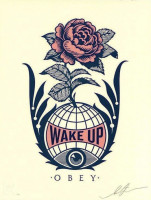
Shepard Fairey
Wake Up Earth, 2020
Limited Edition Print
Mixed Media
GBP 3,200
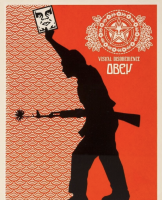
Shepard Fairey
Visual Disobedience, 2004
Limited Edition Print
Screen-print
GBP 3,500
Shepard Fairey
Covert To Overt (gold), 2016
Limited Edition Print
Screen-print
GBP 4,700

Shepard Fairey
Obey, 1970
Limited Edition Print
Offset Print
EUR 1,000

Shepard Fairey
Enhanced Disintegration (Pink), 2019
Limited Edition Print
Screen-print
GBP 1,000

Shepard Fairey
Obey (Ripped), 2001
Limited Edition Print
Lithograph
GBP 1,200

Shepard Fairey
Tribute To Ai Weiwei, 2014
Limited Edition Print
Screen-print
EUR 1,875

Shepard Fairey
Obey, 2019
Limited Edition Print
Mixed Media
Currently Not Available

Shepard Fairey
Demagogue, 2016
Limited Edition Print
Offset Print
Currently Not Available
Related Artists


Related Articles

Art Movements - June 23, 2023
Graffiti Time Lines on Urban Murals: Uncovering a Street Art Makeover
Explore the evolution of graffiti and street art, from urban murals to mainstream galleries. Discover artists and works reshaping public spaces worldwide. Read More

What is Lettrism?
Lettrism is an art form that uses letters, words, and symbols to create artwork. The movement was established in Paris in the 1940s and later gained popularity in the 1950s in America. Lettrisme is the French spelling of the movement's name, derived from the French word for letter.