Details
Artist
Styles
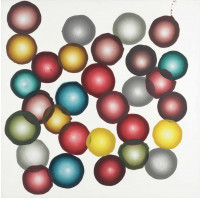
Screenprint // Ross Bleckner's PS I (1997) is an evocative screenprint that showcases his mastery of abstract, ethereal forms. The composition features a mesmerizing collection of floating, flower-like shapes rendered in vibrant shades of red, green, and yellow, set against a deep, atmospheric background. The circular forms, with their soft edges and blended transitions, appear to hover, creating a sense of depth and motion that pulls the viewer into a dreamlike, cosmic landscape. The interplay of light and shadow, coupled with the bold use of color, evokes a meditative and contemplative mood. Bleckner’s abstract approach in this work suggests themes of transience and transformation, inviting viewers to reflect on the ephemeral beauty of life.
PS I, 1997
form
Medium
Size
106.7 x 83.8 cm
- Inches
- Centimeters
Edition
Price
- USD
- EUR
- GBP
Details
Artist
Styles
Screenprint // Ross Bleckner's PS I (1997) is an evocative screenprint that showcases his mastery of abstract, ethereal forms. The composition features a mesmerizing collection of floating, flower-like shapes rendered in vibrant shades of red, green, and yellow, set against a deep, atmospheric background. The circular forms, with their soft edges and blended transitions, appear to hover, creating a sense of depth and motion that pulls the viewer into a dreamlike, cosmic landscape. The interplay of light and shadow, coupled with the bold use of color, evokes a meditative and contemplative mood. Bleckner’s abstract approach in this work suggests themes of transience and transformation, inviting viewers to reflect on the ephemeral beauty of life.
- Recently Added
- Price (low-high )
- Price (high-low )
- Year (low-high )
- Year (high-low )
Ross Bleckner
Untitled, 2001
Painting
Mixed Media
Inquire For Price

Ross Bleckner
PS III, 1997
Limited Edition Print
Screen-print
USD 3,575

Ross Bleckner
PS I, 1997
Limited Edition Print
Screen-print
USD 3,575

Ross Bleckner
September 23rd Bis (variant 4), 2016
Limited Edition Print
Lithograph
EUR 1,800

Ross Bleckner
September 23rd Bis (variant 5), 2016
Limited Edition Print
Lithograph
EUR 1,800

Ross Bleckner
September 23rd Bis (variant 6), 2016
Limited Edition Print
Lithograph
EUR 1,800

Ross Bleckner
September 23rd Bis (variant 3), 2016
Limited Edition Print
Lithograph
EUR 1,800

Ross Bleckner
September 23rd, 2016
Limited Edition Print
Lithograph
EUR 1,800

Ross Bleckner
November 27th, 2016
Limited Edition Print
Lithograph
EUR 1,800

Ross Bleckner
November 29th, 2016
Limited Edition Print
Lithograph
EUR 1,800

Ross Bleckner
Dream And Do I, 1997
Limited Edition Print
Screen-print
USD 3,400

Ross Bleckner
Dream And Do II, 1997
Limited Edition Print
Screen-print
USD 3,400

Ross Bleckner
September 23rd Bis (variant 1), 2016
Limited Edition Print
Lithograph
Currently Not Available
Related Artists


Related Articles

Popular, Art Movements - November 20, 2024
Understanding Abstract Expressionism: Emotion and Gesture
Explore the emotional depth of Abstract Expressionism! Discover how artists like Pollock and Rothko used gesture and color to convey human complexity. Read More

What is abstract art?
Abstract art uses form, shape, line, and color to create a visual experience without attempting to represent external reality. The composition exists independently of the world's visual references, focusing on expressing ideas and emotions through non-representational means.