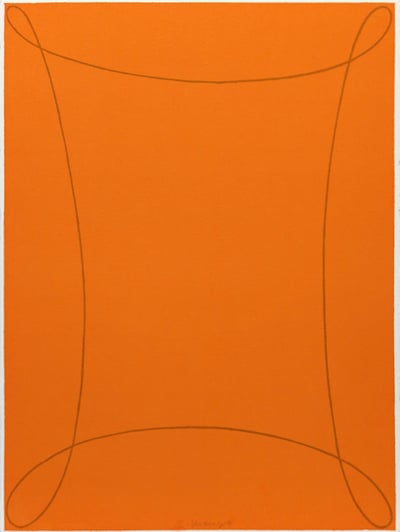
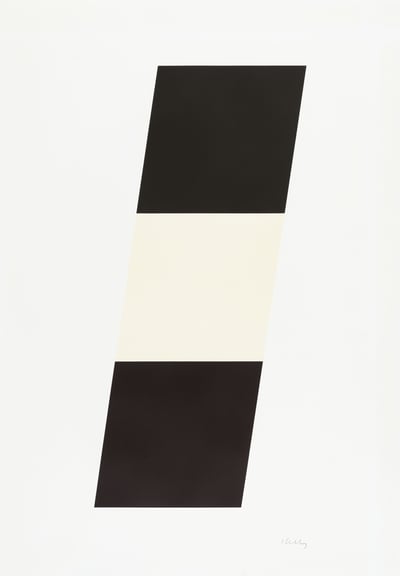
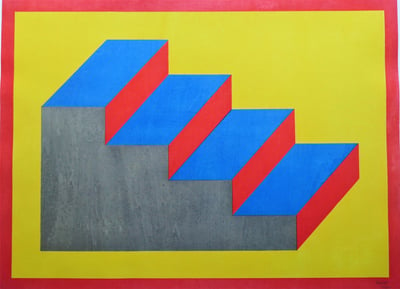
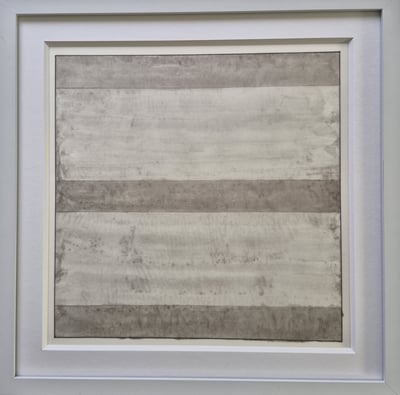
Screenprint in colors on Fabriano paper
- The Complete set of Nine Screenprints
- Signed and Numbered
- 11.63 x 23.88 inches (each)
- Co-published by Edition Domberger, Filderstadt, West Germany and Parasol Press, New York
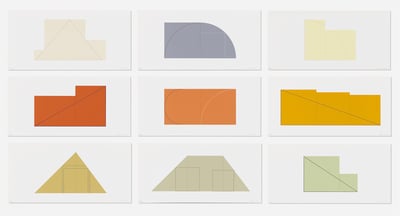
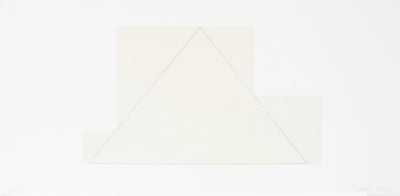
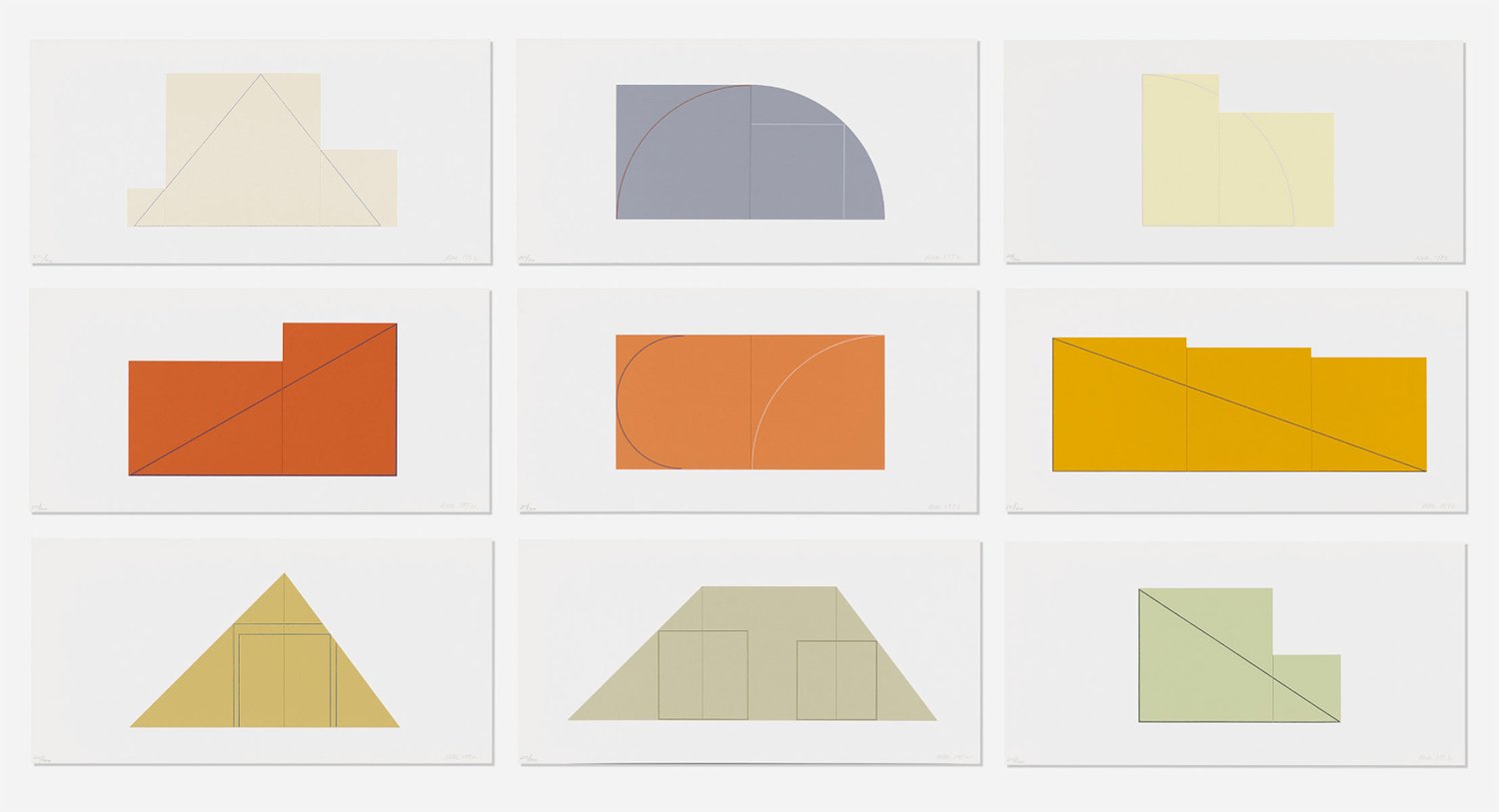
Robert Mangold's Multiple Panel Paintings, Suite (1992) is a series of nine screenprints on Fabriano paper, each measuring 11.63 x 23.88 inches. The set showcases Mangold's minimalist geometric aesthetic, featuring variations of shapes such as triangles, rectangles, and semicircles, all rendered in muted and earthy tones—such as ochre, terracotta, gray, and cream. Each print is composed with precise, thin lines that intersect and divide the forms, creating a sense of architectural balance and harmony. The use of color and form varies between the panels, emphasizing the exploration of structure and repetition within Mangold’s practice. The series exemplifies his focus on the interplay between simplicity, shape, and spatial arrangement, inviting viewers to contemplate the subtle variations and relationships between the panels.
Robert Mangold (United States, 1937) is a minimalist artist renowned for his geometric abstractions that explore the interplay of shape, line, and color. His work often features subtle color palettes and hand-drawn graphite lines, creating a harmonious balance between form and space. Mangold's paintings and prints have been exhibited internationally, influencing contemporary abstract art.
Screen-printScreen printing is a technique where ink is transferred through a mesh onto a substrate, with areas blocked by a stencil to prevent ink from passing through. This method, also known as serigraphy or silkscreen printing, is commonly used to produce prints on posters, T-shirts, vinyl, stickers, wood, and other materials. The process is a type of stencil printing, allowing for vibrant, detailed designs on various surfaces.
Screenprint in colors on Fabriano paper
- The Complete set of Nine Screenprints
- Signed and Numbered
- 11.63 x 23.88 inches (each)
- Co-published by Edition Domberger, Filderstadt, West Germany and Parasol Press, New York
Robert Mangold's Multiple Panel Paintings, Suite (1992) is a series of nine screenprints on Fabriano paper, each measuring 11.63 x 23.88 inches. The set showcases Mangold's minimalist geometric aesthetic, featuring variations of shapes such as triangles, rectangles, and semicircles, all rendered in muted and earthy tones—such as ochre, terracotta, gray, and cream. Each print is composed with precise, thin lines that intersect and divide the forms, creating a sense of architectural balance and harmony. The use of color and form varies between the panels, emphasizing the exploration of structure and repetition within Mangold’s practice. The series exemplifies his focus on the interplay between simplicity, shape, and spatial arrangement, inviting viewers to contemplate the subtle variations and relationships between the panels.
Robert Mangold (United States, 1937) is a minimalist artist renowned for his geometric abstractions that explore the interplay of shape, line, and color. His work often features subtle color palettes and hand-drawn graphite lines, creating a harmonious balance between form and space. Mangold's paintings and prints have been exhibited internationally, influencing contemporary abstract art.
Art feeds off art...and artists feed off artists.
- Robert Mangold
Robert Mangold is a minimalist artist from New York who primarily uses acrylic and pencil on canvas. Minimalism is an art form that started in New York during the 1950s that is known for its simplicity and is devoid of any personal expression from the artist. Robert Mangold initially received his art training at the Cleveland Institute of Art from 1956-1959 in Ohio before transferring to Yale University where he received a BFA (’61) and MFA (’63). Robert Mangold is known for painting shapes such as rings, columns, crosses and trapezoids and will overlap multiple shapes on a single piece of work. As a minimalist, he focuses on taking various architectural forms and reduces them to their basic elements and shapes while using a monochromatic color scheme. A couple of other notable minimalist artists include Donald Judd and Frank Stella. Robert Mangold’s art is a reflection of a time and place where the minimalist movement began.
Geometric abstraction is a form of abstract art that uses geometric shapes arranged in a non-illusionistic space (though not always) and combined into non-representational (non-objective) compositions. Based on years of artistic research, some artists have proposed that geometric abstraction offers a solution to modern challenges by rejecting traditional illusionistic practices in favor of clarity and simplicity.