// Use the Moon by Raymond Pettibon, created in 1991, is a captivating lithograph that combines Pettibon’s signature bold lines with a romantic yet mysterious narrative. The artwork depicts a couple locked in an intimate embrace, rendered in high-contrast black and white. Only the silhouettes of their profiles and a single, luminous moon in the background are visible, heightening the sense of mystery. The phrase USE THE MOON at the top of the composition adds an enigmatic layer, inviting viewers to interpret the symbolic meaning of the moon within this romantic context. Pettibon's minimalist style and use of shadow create a striking and emotionally charged scene that feels timeless and cinematic, leaving much to the imagination.
Raymond Pettibon (USA, 1957) is a contemporary artist known for his graphic, text-laden drawings that merge pop culture, literature, and politics. Emerging from the punk rock scene, including designing for Black Flag, Pettibon’s works explore dark humor and subversion. His distinctive style is widely exhibited in galleries and museums worldwide.
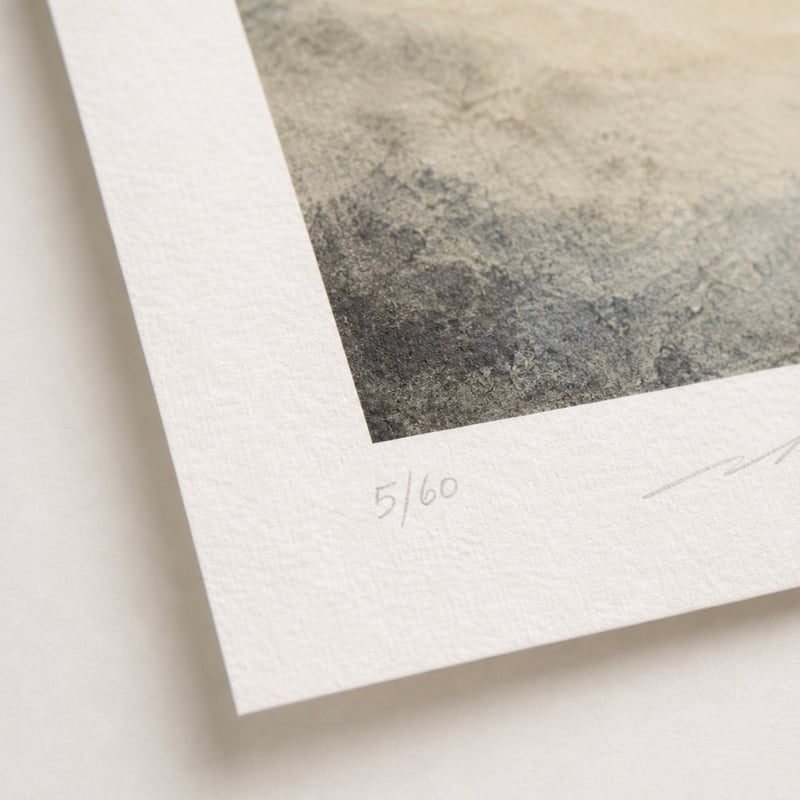
LithographLithography is a printing method based on the principle that water and oil do not mix. It can be used to print artwork or text onto paper or other suitable materials. Traditionally, an image was drawn with wax, fat, or oil onto a lithographic limestone surface or plate. Today, metal plates and other surfaces are also used in lithographic printing.
// Use the Moon by Raymond Pettibon, created in 1991, is a captivating lithograph that combines Pettibon’s signature bold lines with a romantic yet mysterious narrative. The artwork depicts a couple locked in an intimate embrace, rendered in high-contrast black and white. Only the silhouettes of their profiles and a single, luminous moon in the background are visible, heightening the sense of mystery. The phrase USE THE MOON at the top of the composition adds an enigmatic layer, inviting viewers to interpret the symbolic meaning of the moon within this romantic context. Pettibon's minimalist style and use of shadow create a striking and emotionally charged scene that feels timeless and cinematic, leaving much to the imagination.
Raymond Pettibon (USA, 1957) is a contemporary artist known for his graphic, text-laden drawings that merge pop culture, literature, and politics. Emerging from the punk rock scene, including designing for Black Flag, Pettibon’s works explore dark humor and subversion. His distinctive style is widely exhibited in galleries and museums worldwide.
Art comes after the fact, as a witness to certain things that have happened.
- Raymond Pettibon
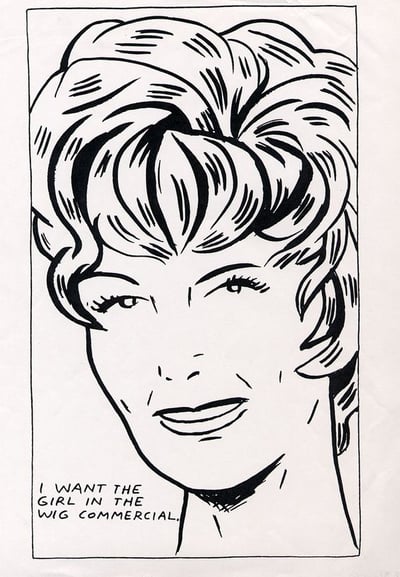
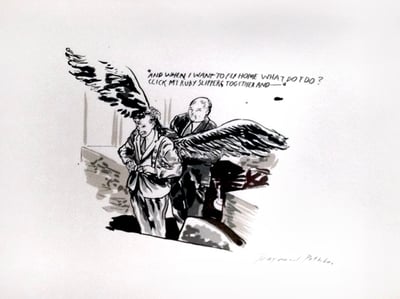
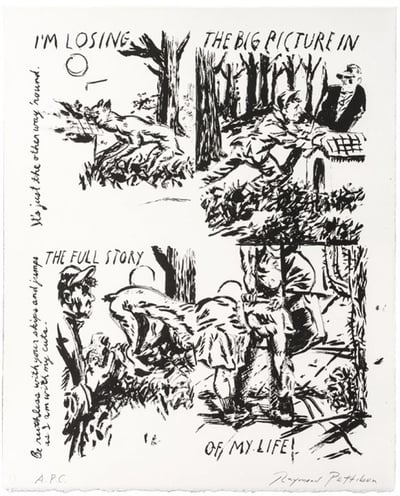
Raymond Pettibon is a prolific contemporary American artist who is known for his drawings, which combine image and text and are often violent, ironic, and/or anti-authoritarian. Much of his illustration is political in nature, and uses black humor to critique contemporary culture. His primary medium is India ink on paper, and many of his works are black and white, although some are colored with watercolors, acrylics, pencils, gouache, or collage. His style is reminiscent of editorial cartoons, and is influenced by William Blake, Edward Hopper, and Francisco Goya. Raymond Pettibon got his start in the punk rock scene in the 1970s, and has created album covers, posters and other ephemera for bands such as Black Flag and Sonic Youth. Since 1978, he has produced limited edition photocopy booklets of his work, which he calls "Superflux Pubs," and from 1981 to 1986 he published his illustrations as an independent magazine,Tripping Corpse. Raymond Pettibon has been the recipient of a number of awards, including the Bucksbaum Award in 2004 and the University of Vienna's Oscar Kokoschka Prize in 2010. (Artist website)
Animation is the process of displaying a sequence of static images in rapid succession to create the illusion of movement. Each image, or frame, is slightly altered from the previous one, particularly in the moving parts, so when shown together, they form a continuous motion. Traditionally, illustrators drew each frame by hand to produce this effect.