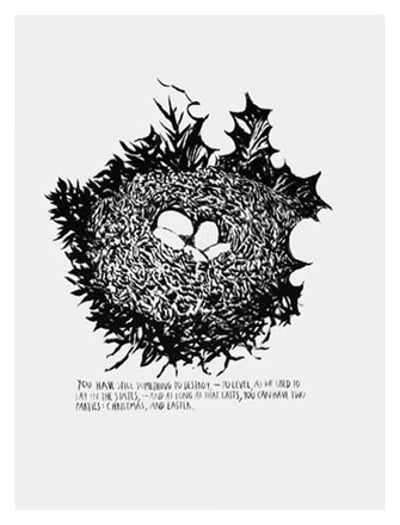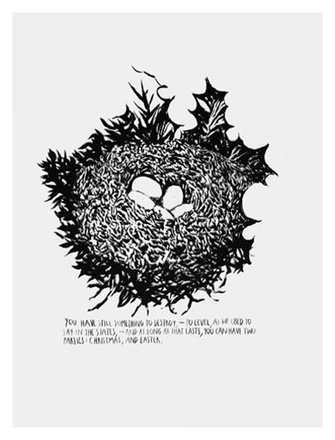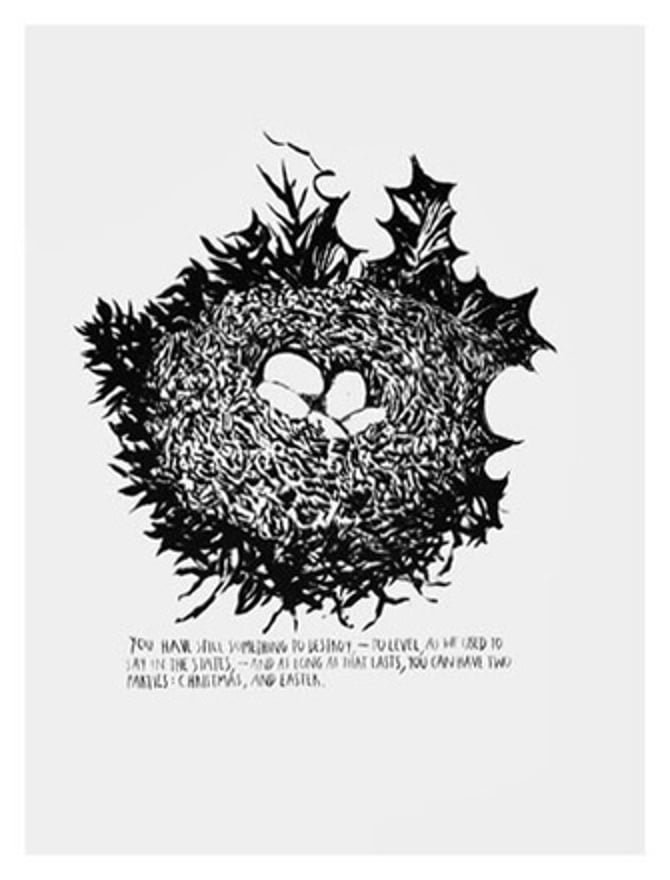
No Title (You have still) by Raymond Pettibon is a silkscreen print that captures a delicate and contemplative scene—a bird’s nest cradling two unhatched eggs, surrounded by thorny leaves. Known for his unique blend of text and imagery, Pettibon adds a cryptic line beneath the image, which reads, You have still something to believe... to level as if lord to sit on the sheets… and as long as that lasts, you can have two families: Charybdis, and Eulera. This text, juxtaposed with the fragile nest, creates a poetic tension, reflecting themes of vulnerability, hope, and duality. Created in 2002, the print measures 91.5 cm in height and 61 cm in width, and is part of a limited edition of 120, capturing Pettibon's distinctive style of introspective and thought-provoking imagery.
Raymond Pettibon (USA, 1957) is a contemporary artist known for his graphic, text-laden drawings that merge pop culture, literature, and politics. Emerging from the punk rock scene, including designing for Black Flag, Pettibon’s works explore dark humor and subversion. His distinctive style is widely exhibited in galleries and museums worldwide.
SilkscreenSilkscreen is a printmaking method that uses a screen made of silk or other mesh fabric. The screen is treated with a substance that blocks ink in certain areas, allowing ink to pass through only in the desired sections. Each color in the print requires a separate screen.
No Title (You have still) by Raymond Pettibon is a silkscreen print that captures a delicate and contemplative scene—a bird’s nest cradling two unhatched eggs, surrounded by thorny leaves. Known for his unique blend of text and imagery, Pettibon adds a cryptic line beneath the image, which reads, You have still something to believe... to level as if lord to sit on the sheets… and as long as that lasts, you can have two families: Charybdis, and Eulera. This text, juxtaposed with the fragile nest, creates a poetic tension, reflecting themes of vulnerability, hope, and duality. Created in 2002, the print measures 91.5 cm in height and 61 cm in width, and is part of a limited edition of 120, capturing Pettibon's distinctive style of introspective and thought-provoking imagery.
Raymond Pettibon (USA, 1957) is a contemporary artist known for his graphic, text-laden drawings that merge pop culture, literature, and politics. Emerging from the punk rock scene, including designing for Black Flag, Pettibon’s works explore dark humor and subversion. His distinctive style is widely exhibited in galleries and museums worldwide.
Art comes after the fact, as a witness to certain things that have happened.
- Raymond Pettibon
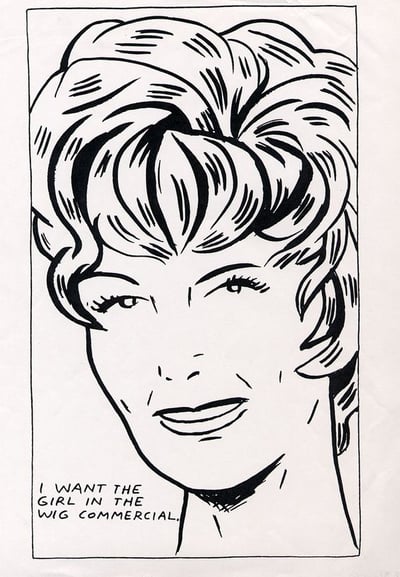
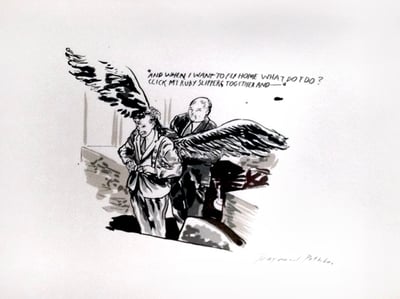
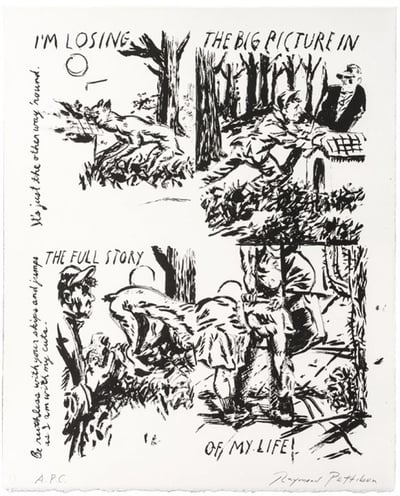
Raymond Pettibon is a prolific contemporary American artist who is known for his drawings, which combine image and text and are often violent, ironic, and/or anti-authoritarian. Much of his illustration is political in nature, and uses black humor to critique contemporary culture. His primary medium is India ink on paper, and many of his works are black and white, although some are colored with watercolors, acrylics, pencils, gouache, or collage. His style is reminiscent of editorial cartoons, and is influenced by William Blake, Edward Hopper, and Francisco Goya. Raymond Pettibon got his start in the punk rock scene in the 1970s, and has created album covers, posters and other ephemera for bands such as Black Flag and Sonic Youth. Since 1978, he has produced limited edition photocopy booklets of his work, which he calls "Superflux Pubs," and from 1981 to 1986 he published his illustrations as an independent magazine,Tripping Corpse. Raymond Pettibon has been the recipient of a number of awards, including the Bucksbaum Award in 2004 and the University of Vienna's Oscar Kokoschka Prize in 2010. (Artist website)
Neo-Figurative Art is a collective term that refers to the revival of figurative art in America and Europe during the 1960s, following a period dominated by abstraction. Michel Ragon, a French art critic, argued that this resurgence of figuration occurred during a critical time of social and political upheaval in both regions.