Details
Artist
Styles
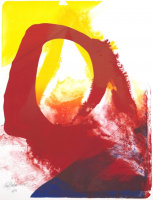
Watercolor and air brush - Signed on the lower right and on the verso - Jenkins wrote the title, date and again signed it - On a 4-ply hand-made paper. // Phenomeana Parcinal Imperative by Paul Jenkins is a vibrant watercolor artwork from 1982, showcasing the artist's skill with fluid color transitions. Executed on handmade, 4-ply paper, this piece combines watercolor and airbrush techniques, allowing the colors to blend and diffuse seamlessly across the surface. Large bands of intense hues—red, green, yellow, and blue—flow together in a mesmerizing, almost dreamlike manner, creating a dynamic composition that radiates energy and movement. Jenkins' signature approach, marked by vibrant color fields and a lack of defined boundaries, invites viewers into a meditative experience, emphasizing the emotional and sensory impact of pure color.
Phenomeana parcinal imperative, 1982
form
Medium
Size
78.7 x 111.8 cm
- Inches
- Centimeters
Edition
Price
- USD
- EUR
- GBP
Details
Artist
Styles
Watercolor and air brush - Signed on the lower right and on the verso - Jenkins wrote the title, date and again signed it - On a 4-ply hand-made paper. // Phenomeana Parcinal Imperative by Paul Jenkins is a vibrant watercolor artwork from 1982, showcasing the artist's skill with fluid color transitions. Executed on handmade, 4-ply paper, this piece combines watercolor and airbrush techniques, allowing the colors to blend and diffuse seamlessly across the surface. Large bands of intense hues—red, green, yellow, and blue—flow together in a mesmerizing, almost dreamlike manner, creating a dynamic composition that radiates energy and movement. Jenkins' signature approach, marked by vibrant color fields and a lack of defined boundaries, invites viewers into a meditative experience, emphasizing the emotional and sensory impact of pure color.
- Recently Added
- Price (low-high )
- Price (high-low )
- Year (low-high )
- Year (high-low )

Paul Jenkins
Untitled, 1960
Drawing / Watercolor
Watercolor
Inquire For Price

Paul Jenkins
Untitled (Black Strokes), 1971
Limited Edition Print
Lithograph
USD 1,580

Paul Jenkins
Untitled (Vibrant Currents), 1972
Limited Edition Print
Lithograph
USD 3,300

Paul Jenkins
Phenomena - Katherine Wheel, 1969
Limited Edition Print
Lithograph
USD 1,450

Paul Jenkins
Phenomena Wing Cut, 1979
Painting
Oil On Canvas
USD 11,900

Paul Jenkins
Phenomeana Parcinal Imperative, 1982
Drawing / Watercolor
Watercolor
USD 11,900
Paul Jenkins
Aspects D’Amadeus Et Les Autres, 1992
Limited Edition Print
Lithograph
USD 1,350
Related Artists


Related Articles

Popular, Art Movements - November 20, 2024
Understanding Abstract Expressionism: Emotion and Gesture
Explore the emotional depth of Abstract Expressionism! Discover how artists like Pollock and Rothko used gesture and color to convey human complexity. Read More
What is Tachisme?
Tachisme is a French abstract painting style that gained popularity between 1940 and 1950, often seen as the European counterpart to Abstract Expressionism. However, there are stylistic differences between the two. Tachisme, which emerged from Art Informel, rejected geometric abstraction in favor of more intuitive and spontaneous expression. It was a reaction against the structured forms of Cubism and is closely related to Informalism. Tachisme emphasizes gestural brushwork, irregular forms, and a focus on the process of painting itself.