Details
Artist
Styles
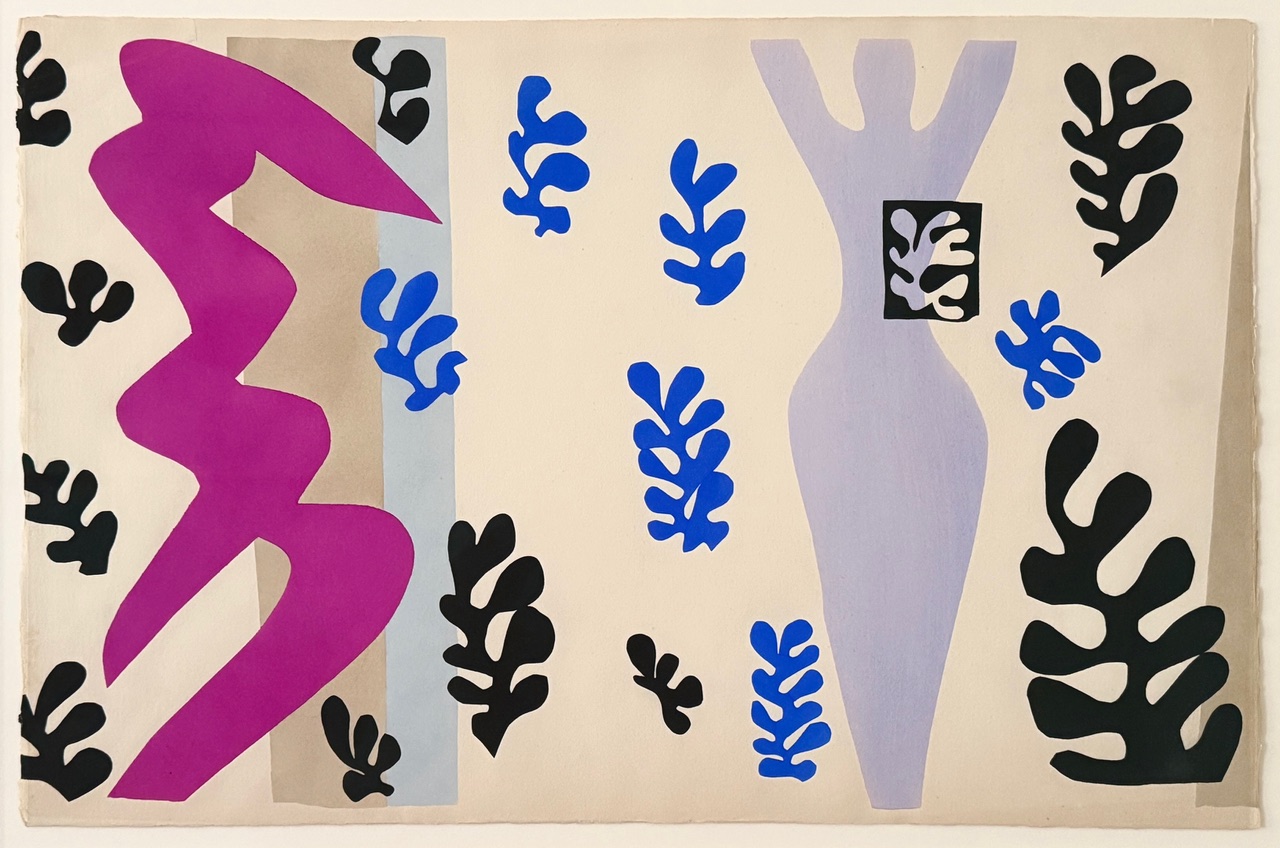
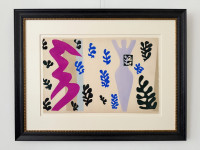
Original pochoir on Arches wove paper. - Edition:100 ex. without centerfold in the plates. Next to the regular edition of 250 copies with center fold. - Printed by Edmond Vaireland, Draeger Frères, Paris - Published by Teriade, Paris - In excellent condition. One small restored tear (1 cm) and crease in the upper left corner and some faint discoloration spots. - Claude Duthuit, Henri Matisse: catalogue raisonné des ouvrages illustrés, Paris, 1988, no. 22, pp. 177 (illustrated in color) Le lanceur de couteaux (The Knife Thrower) from Jazz (1947) by Henri Matisse exemplifies the artist’s late-career mastery of the pochoir technique. Using bold, organic cut-out forms in vibrant magenta, lavender, cobalt, and black, Matisse arranges silhouettes that suggest motion and duality—likely representing both the knife thrower and the target. The composition plays with symmetry and negative space, using stylized leaf-like shapes to create visual rhythm. Published by Tériade and printed by Draeger Frères, this pochoir was part of a rare edition of 100 impressions issued without the centerfold, unlike the standard version. Originally conceived as part of the Jazz portfolio—a landmark artist’s book—this work reflects Matisse’s interest in theatrical themes and the dynamism of performance. The poetic abstraction and color harmonies evoke joy, tension, and spectacle through visual metaphor, making it one of the most iconic images from Jazz.
Le lanceur de couteaux, from Jazz, 1947
form
Medium
Size
42 x 65 cm
- Inches
- Centimeters
Edition
Price
- USD
- EUR
- GBP
Details
Artist
Styles
Original pochoir on Arches wove paper. - Edition:100 ex. without centerfold in the plates. Next to the regular edition of 250 copies with center fold. - Printed by Edmond Vaireland, Draeger Frères, Paris - Published by Teriade, Paris - In excellent condition. One small restored tear (1 cm) and crease in the upper left corner and some faint discoloration spots. - Claude Duthuit, Henri Matisse: catalogue raisonné des ouvrages illustrés, Paris, 1988, no. 22, pp. 177 (illustrated in color) Le lanceur de couteaux (The Knife Thrower) from Jazz (1947) by Henri Matisse exemplifies the artist’s late-career mastery of the pochoir technique. Using bold, organic cut-out forms in vibrant magenta, lavender, cobalt, and black, Matisse arranges silhouettes that suggest motion and duality—likely representing both the knife thrower and the target. The composition plays with symmetry and negative space, using stylized leaf-like shapes to create visual rhythm. Published by Tériade and printed by Draeger Frères, this pochoir was part of a rare edition of 100 impressions issued without the centerfold, unlike the standard version. Originally conceived as part of the Jazz portfolio—a landmark artist’s book—this work reflects Matisse’s interest in theatrical themes and the dynamism of performance. The poetic abstraction and color harmonies evoke joy, tension, and spectacle through visual metaphor, making it one of the most iconic images from Jazz.
- Recently Added
- Price (low-high )
- Price (high-low )
- Year (low-high )
- Year (high-low )
Henri Matisse
One Plate, From Cinquante Dessins (Duthuit Books 2), 1920
Limited Edition Print
Etching
Inquire For Price

Henri Matisse
Le Lanceur De Couteaux, From Jazz, 1947
Limited Edition Print
Mixed Media
EUR 22,900

Henri Matisse
La Robe Jaune Au Ruban Noir, 1922
Limited Edition Print
Lithograph
USD 25,000 - 50,000

Henri Matisse
Espanol, c. 1925
Drawing / Watercolor
Mixed Media
Inquire For Price

Henri Matisse
L'Espagnol à La Mantille, 1925
Limited Edition Print
Etching And Aquatint
EUR 3,100

Henri Matisse
D416 Le Repos Du Modele, 1922
Limited Edition Print
Lithograph
USD 8,600

Henri Matisse
D236 Nausicaa Ulyssess Pl202, 1935
Limited Edition Print
Lithograph
USD 10,500
Related Artists


Related Articles

Artists - February 14, 2025
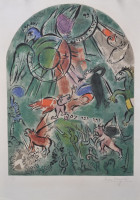
Evergreen Artists: Why Picasso, Matisse, Miró and Chagall Remain Relevant Today
Discover the timeless appeal of Picasso, Matisse, Miró, and Chagall. Explore their lasting impact and shop high-quality prints at Composition.Gallery. Read More
What is Eat Art?
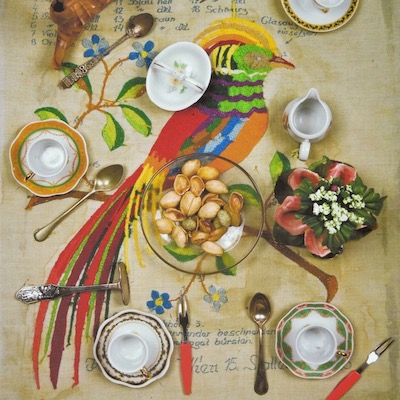
EAT (Experiments in Art and Technology) was a movement formed to foster collaborations between engineers and artists. It facilitated direct, person-to-person connections between these two groups. The movement was originally launched in 1967 by artists Robert Whitman and Robert Rauschenberg, along with engineers Fred Waldhauer and Billy Klüver. EAT carried out various projects and activities that expanded the role of artists in contemporary society, encouraging the integration of art and technology.