What is Naive Art?
Naïve art describes a style of artwork that is simple and unsophisticated, often created by artists without formal training in an academy or art school. The style is characterized by a lack of advanced techniques, giving it a childlike appearance. Naïve art often features bright colors, simple shapes, and a straightforward approach to subject matter, reflecting the artist's untrained perspective.
- Show All
- Established
- Discoveries
ARTWORKS RELATED TO NAIVE ART

Pierre Soulages
Eau-forte III, 1956
Limited Edition Print
Etching
EUR 10,800

Pablo Picasso
La plainte des femmes, 1933 / 1961
Limited Edition Print
Mixed Media
Inquire For Price

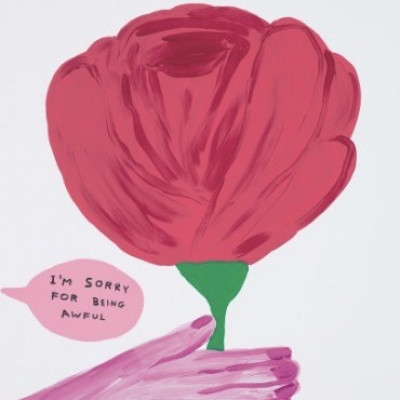
David Shrigley
I'm Sorry For Being Awful, 2018
Limited Edition Print
Screen-print
GBP 3,900

Yoshitomo Nara
Days (2014-18), 2018
Limited Edition Print
Pigment print
GBP 9,950

David Shrigley
I Love Pets, 2019
Limited Edition Print
Screen-print
GBP 5,400

Pablo Picasso
Oursin (A.R. 268), 1955
Sculpture / Object
Plate
USD 7,000 - 9,000

Pablo Picasso
Picador (Bullfighter), 1953
Sculpture / Object
Plate
USD 7,000 - 9,000

Pablo Picasso
Peintre à Lavallière dessinant son modèle dans le Cadre de la Maison Tellier (from la Série 156), 1970
Limited Edition Print
Etching
Inquire For Price

Pablo Picasso
Couple d'Oiseaux II, 1966
Limited Edition Print
Etching and Aquatint
Inquire For Price

Pablo Picasso
Filles entre elles, dont une avec une fleur, 1971
Limited Edition Print
Drypoint
Inquire For Price

Pablo Picasso
Mousquetaire, Abbé en Priére, Vieillard a la Chouette Et Odalisque: Méduse, Vierge ou Smple Femme?, 1970
Limited Edition Print
Etching
Inquire For Price

Pablo Picasso
60 Years of Graphic Works, 1966
Limited Edition Print
Lithograph
Inquire For Price

Pablo Picasso
Le Clown, 1961
Limited Edition Print
Lithograph
USD 7,850

Pablo Picasso
Bouquet de fleurs, 1958
Limited Edition Print
Offset Print
USD 8,700
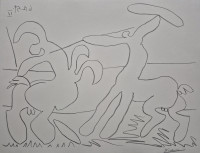
Pablo Picasso
Combat de centaures IV, 1959
Limited Edition Print
Lithograph
EUR 7,200
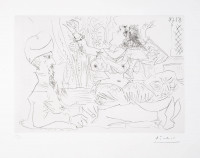
Pablo Picasso
Reclining Man in Turban and Belly Dancer, 1968
Limited Edition Print
Mixed Media
USD 3,950
Related Articles

Artists - November 04, 2024
Nara: 'Cosmic Girl' Print Series (1999-2020): A Technical and Market Analysis
Delve into Yoshitomo Nara’s iconic Cosmic Girl series (1999–2020). Explore its artistic innovation, market dynamics, and technical evolution in printmaking. Read More


Chalk is a natural mineral, primarily composed of calcium carbonate. In art, chalk refers to sticks used for drawing, made from a mixture of chalk, colored pigments, and gum Arabic. These sticks are usually shaped into four flat sides for easier handling.
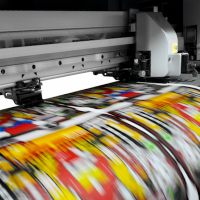
Computer printing involves using computer technology to reproduce fine art images as prints. In its basic form, this means creating digital versions of artwork that are printed onto paper. More advanced techniques allow artists to program computers to generate original art, which is then printed using various printing technologies.