What is a Lithograph?
Lithography is a printing method based on the principle that water and oil do not mix. It can be used to print artwork or text onto paper or other suitable materials. Traditionally, an image was drawn with wax, fat, or oil onto a lithographic limestone surface or plate. Today, metal plates and other surfaces are also used in lithographic printing.
- Show All
- Established
- Discoveries
ARTWORKS RELATED TO LITHOGRAPH

Agnes Martin
Untitled (from Paintings and Drawings: 1974-1990), 1991
Limited Edition Print
Lithograph
EUR 8,600

Marc Chagall
The Bay of Angels (La Baie des Anges), 1962
Limited Edition Print
Lithograph
EUR 7,200

Mel Ramos
Hav a Havanna #7, 2008
Limited Edition Print
Lithograph
Inquire For Price

Antonio Saura
Toda persona tiene derecho a la libertad de reunion y de asociacion pacificas, 1984
Limited Edition Print
Lithograph
EUR 1,250

Antonio Saura
Melanchton III, 1988
Limited Edition Print
Lithograph
EUR 1,650

Antonio Saura
Melanchton II, 1988
Limited Edition Print
Lithograph
EUR 1,650

Antonio Saura
Don, 1988
Limited Edition Print
Lithograph
EUR 1,650

Antonio Saura
Philippe II, 1988
Limited Edition Print
Lithograph
EUR 1,650

Antonio Saura
Melanchton I, 1988
Limited Edition Print
Lithograph
EUR 1,650

Antonio Saura
Foule, 1989
Limited Edition Print
Lithograph
EUR 2,200

Louise Bourgeois
Jitterbug, 1998
Limited Edition Print
Lithograph
GBP 11,000 - 15,000

Antonio Saura
Serie Abierta IV, 1989
Limited Edition Print
Lithograph
EUR 1,350

Alex Katz
Late July 2, 1971
Limited Edition Print
Lithograph
EUR 10,800

David Hockney
Celia (La Bergère), 1981
Limited Edition Print
Lithograph
USD 26,900

Robert Longo
Men in the Cities, Tokyo, Seibu Department Stores, Ltd. V (Single Man) & IV (Single Woman), 1990
Limited Edition Print
Lithograph
USD 68,000 - 75,000

Julian Schnabel
per non dimenticare, 1997
Limited Edition Print
Lithograph
EUR 3,000
Related Articles

Collecting - December 12, 2024
The Art of Printmaking: From Woodcuts to Lithographs
Explore the rich history of printmaking, from ancient woodcuts to modern lithography. Discover how artists have pushed this versatile medium's boundaries. Read More

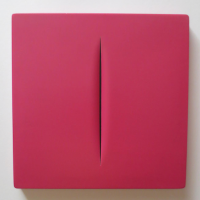
Spatialism is an art movement that originated in Italy in 1947, founded by Lucio Fontana with the intention of synthesizing sound, color, movement, and space into a new form of art. The movement's central ideas were outlined in Fontana's first manifesto, published in 1947, where he introduced the concept of spatial art to capture the spirit of the post-war era. His ideas were further developed in five subsequent manifestos. Although Fontana's ideas were sometimes considered vague, his influence was significant, as he was one of the first European artists to emphasize art as a performance and gesture.

A Chinese term that describes performance art. This concept is relatively new and may be challenging to articulate unless people understand the intentions behind it. It is a flexible concept that emphasizes everyday, common, and community-focused elements. The art form is heightened, refined, and reflective of how people behave, move, and live.