Details
Artist
Styles
Già Collezione Livio Collina Bologna. // Sandro Chia's Disegno di Donna (1974) presents a hauntingly minimalist composition that captures a delicate and ethereal figure enveloped in a soft green aura. Rendered in oil on canvas, this painting centers on a faint, almost ghostly outline of a reclining female form. The figure’s pale contours are gently suspended within a diffused green cloud, creating a sense of introspection and otherworldliness. This 100 cm square artwork invites contemplation on themes of presence and absence, as Chia blurs the line between form and void, hinting at an emotional depth within the simplicity of his palette and brushwork. The painting, part of the Già Collezione Livio Collina in Bologna, exemplifies Chia’s ability to evoke complex emotions through minimalist techniques.
Disegno di Donna, 1974
form
Medium
Size
100 x 100 cm
- Inches
- Centimeters
Edition
Price
- USD
- EUR
- GBP
Details
Artist
Styles
Già Collezione Livio Collina Bologna. // Sandro Chia's Disegno di Donna (1974) presents a hauntingly minimalist composition that captures a delicate and ethereal figure enveloped in a soft green aura. Rendered in oil on canvas, this painting centers on a faint, almost ghostly outline of a reclining female form. The figure’s pale contours are gently suspended within a diffused green cloud, creating a sense of introspection and otherworldliness. This 100 cm square artwork invites contemplation on themes of presence and absence, as Chia blurs the line between form and void, hinting at an emotional depth within the simplicity of his palette and brushwork. The painting, part of the Già Collezione Livio Collina in Bologna, exemplifies Chia’s ability to evoke complex emotions through minimalist techniques.
- Recently Added
- Price (low-high )
- Price (high-low )
- Year (low-high )
- Year (high-low )
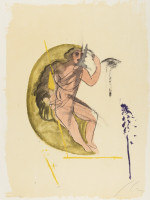
Sandro Chia
Untitled (Columbus: In Search Of A New Tomorrow), 1992
Limited Edition Print
Screen-print
Inquire For Price

Sandro Chia
Senza Titolo (Tavolo), 2001
Sculpture / Object
Mixed Media
Inquire For Price

Sandro Chia
Lonely Explore, 1991
Limited Edition Print
Lithograph
EUR 1,900

Sandro Chia
Elektra, 1995
Limited Edition Print
Mixed Media
EUR 2,500

Sandro Chia
Figure Con Albero, 1994
Sculpture / Object
Ceramic
EUR 7,300

Sandro Chia
Volti (faces)
Limited Edition Print
Etching And Aquatint
EUR 1,300

Sandro Chia
Untitled (Portrait), 1991
Limited Edition Print
Etching
EUR 2,100

Sandro Chia
Figura, 1974
Painting
Oil On Canvas
EUR 9,500

Sandro Chia
Disegno Di Donna, 1974
Painting
Oil On Canvas
EUR 9,500
Related Artists


Related Articles

Art Movements - November 15, 2022
Transavanguardia: an Italian Renaissance, Beyond Neo Expressionism
Explore the Transavanguardia movement, an Italian Neo-Expressionist renaissance. Discover its bold artists and their revival of tradition through modern innovation. Read More

What is Postmodernism?
Postmodernism is an art movement that emerged as a reaction against authority and traditional boundaries, seeking to blur the lines between art and everyday life. It aimed to bridge the gap between the cultural elite and the general public by embracing eclectic mixtures of earlier conventions and styles. Postmodernist art often challenges established norms and celebrates diversity, irony, and pastiche, making it a movement that reflects the complexities of contemporary culture.