Details
Artist
Styles
Wood box with five drawers, formica, glass, mirror, brass, and horsehair. Executed in 1971, this work is from an edition of 50 published by Castelli Graphics and Multiples, Inc. // Untitled (Box with Drawers) by Richard Artschwager, created in 1971, is a sculptural object that challenges perceptions of functionality and art. This unique piece consists of a wooden box with five drawers, incorporating materials such as formica, glass, mirror, brass, and horsehair, which give it an intriguing, tactile quality. The structure resembles a minimalist cabinet or chest, but its use of unconventional materials and the juxtaposition of textures transform it into an artwork that questions the boundaries between utilitarian objects and sculptural form. Each drawer offers a different experience with its varied linings, inviting curiosity about the intended function and encouraging viewers to explore it as both an object and a statement. Part of an edition of 50, this work reflects Artschwager’s interest in blending art with the everyday, merging the familiar with the abstract.
Untitled (Box with drawers), 1971
form
Medium
Size
37 x 29 X 33 cm
- Inches
- Centimeters
Edition
Price
Details
Artist
Styles
Wood box with five drawers, formica, glass, mirror, brass, and horsehair. Executed in 1971, this work is from an edition of 50 published by Castelli Graphics and Multiples, Inc. // Untitled (Box with Drawers) by Richard Artschwager, created in 1971, is a sculptural object that challenges perceptions of functionality and art. This unique piece consists of a wooden box with five drawers, incorporating materials such as formica, glass, mirror, brass, and horsehair, which give it an intriguing, tactile quality. The structure resembles a minimalist cabinet or chest, but its use of unconventional materials and the juxtaposition of textures transform it into an artwork that questions the boundaries between utilitarian objects and sculptural form. Each drawer offers a different experience with its varied linings, inviting curiosity about the intended function and encouraging viewers to explore it as both an object and a statement. Part of an edition of 50, this work reflects Artschwager’s interest in blending art with the everyday, merging the familiar with the abstract.
- Recently Added
- Price (low-high )
- Price (high-low )
- Year (low-high )
- Year (high-low )

Richard Artschwager
Liebespaar (Lovers), 2005
Limited Edition Print
Serigraph
USD 1,650

Richard Artschwager
Untitled (Box With Drawers), 1971
Sculpture / Object
Wood
Currently Not Available
Related Artists


Related Articles

Popular, News, Collecting - March 28, 2025
The State of the Art Market 2025
Discover key 2025 art market trends—from online sales and NFTs to collector behavior and investment shifts shaping the global art scene. Read More

What is geometric abstract art?
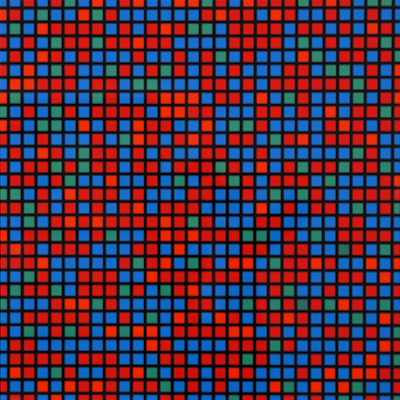
Geometric abstraction is a form of abstract art that uses geometric shapes arranged in a non-illusionistic space (though not always) and combined into non-representational (non-objective) compositions. Based on years of artistic research, some artists have proposed that geometric abstraction offers a solution to modern challenges by rejecting traditional illusionistic practices in favor of clarity and simplicity.