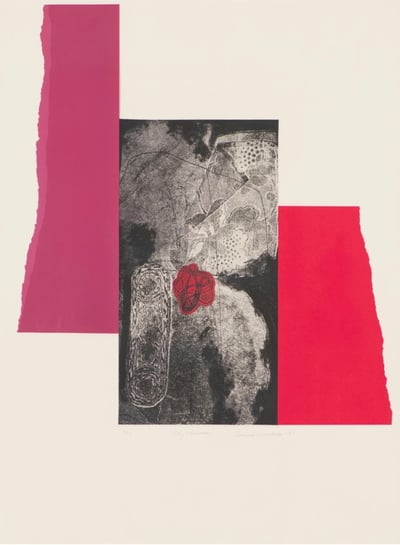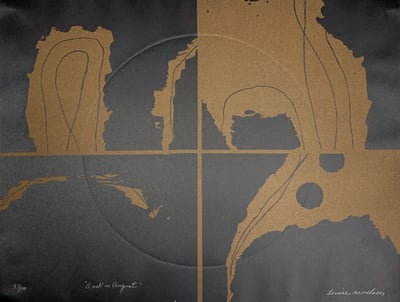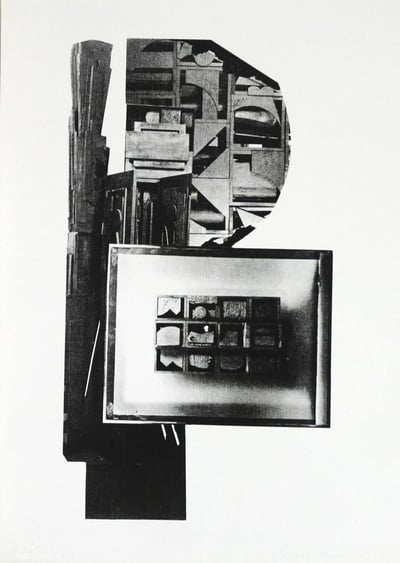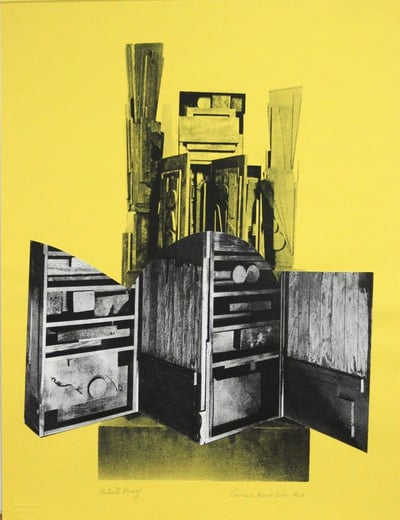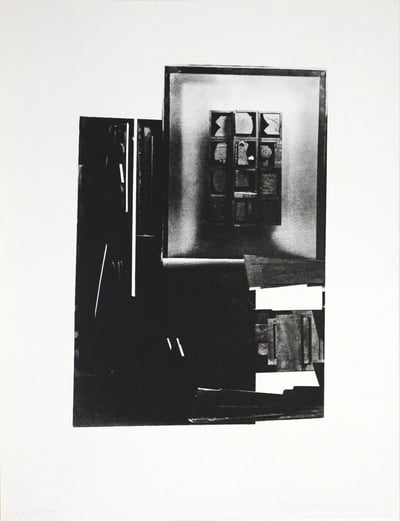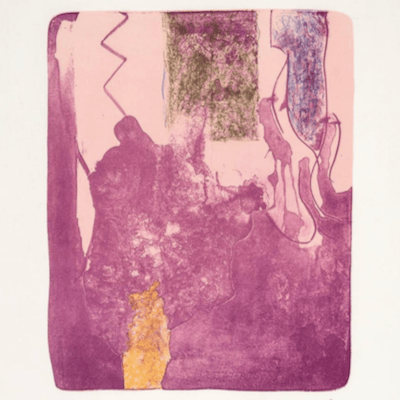
Original Serigraph on Paper and Acetate - From the rare limited edition of 125 - Published by Harry N. Abrams Inc. In collaboration with The Pace Gallery New York. - Suite: Facade - In excellent condition - Hand Signed by the srtist
Clowns' Houses by Louise Nevelson is a complex, layered serigraph that reflects her signature style of assembling architectural forms and textures. Created in 1966, this limited edition print combines intricate, shadowy shapes, evoking a surreal, almost industrial landscape. The abstract forms resemble fragmented building facades, conveying a sense of urban isolation and mystery. Printed on paper and acetate, this piece uses overlapping and semi-transparent effects to add depth and complexity, creating an illusion of a three-dimensional sculpture. Known for her assemblage work, Nevelson’s exploration of geometric shapes and muted tones in Clowns' Houses invites viewers to interpret the interplay of structure and emptiness, possibly alluding to themes of confinement and the enigmatic quality of urban life.
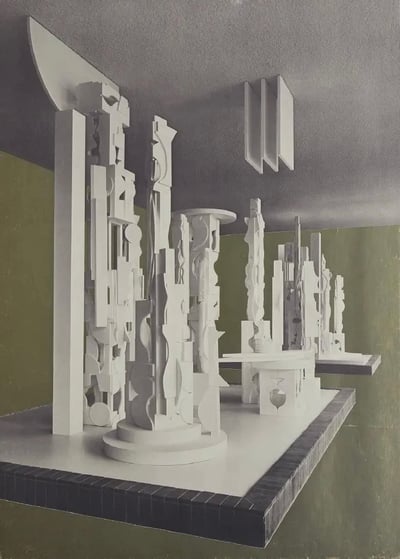
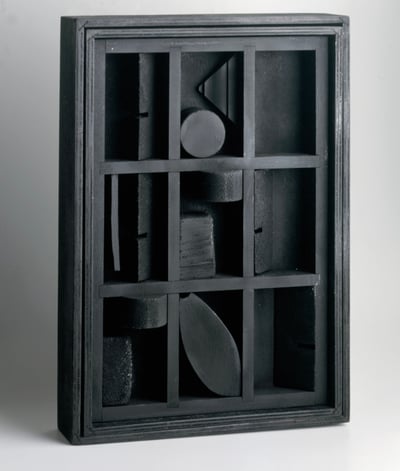
Louise Nevelson (USA, 1899–1988) was a pioneering sculptor known for her monumental, monochromatic assemblages crafted from wood and found objects. Her works, often painted in black, white, or gold, create intricate, architectural compositions. Nevelson’s innovative approach to abstraction and use of recycled materials established her as a key figure in 20th-century sculpture.
SerigraphSerigraph is a printmaking process that uses silk screen techniques to create an image. The image is digitally separated into individual colors, each of which is assigned to a separate silk screen. These screens are then used to apply each color by hand, layer by layer, to replicate the original artwork, often based on an oil painting.
Original Serigraph on Paper and Acetate - From the rare limited edition of 125 - Published by Harry N. Abrams Inc. In collaboration with The Pace Gallery New York. - Suite: Facade - In excellent condition - Hand Signed by the srtist
Clowns' Houses by Louise Nevelson is a complex, layered serigraph that reflects her signature style of assembling architectural forms and textures. Created in 1966, this limited edition print combines intricate, shadowy shapes, evoking a surreal, almost industrial landscape. The abstract forms resemble fragmented building facades, conveying a sense of urban isolation and mystery. Printed on paper and acetate, this piece uses overlapping and semi-transparent effects to add depth and complexity, creating an illusion of a three-dimensional sculpture. Known for her assemblage work, Nevelson’s exploration of geometric shapes and muted tones in Clowns' Houses invites viewers to interpret the interplay of structure and emptiness, possibly alluding to themes of confinement and the enigmatic quality of urban life.
Louise Nevelson (USA, 1899–1988) was a pioneering sculptor known for her monumental, monochromatic assemblages crafted from wood and found objects. Her works, often painted in black, white, or gold, create intricate, architectural compositions. Nevelson’s innovative approach to abstraction and use of recycled materials established her as a key figure in 20th-century sculpture.
You must create your own world. I am responsible for my world.
- Louise Nevelson
Louise Nevelson is especially well known for her monochromatic wooden wall pieces and sculptures which are located permanently in the outdoors. Before centering her work as a sculptor, she tried out work in the media of painting and printing. However, it became clear that sculpture was where the strength lay. Most of her pieces are made out of wood and they appear almost puzzle lie. There are usually lots of different defined pieces which come together to create a whole. They are either standing independently or fixed to a wall. She likes to make work in monochromatic black and white as it adds to the starkness of the sculpture. Known internationally she has exhibited widely and her work can be found in museums and galleries across the world. She is probably one of the most famous and important figures in twentieth century sculpture history.
Abstract Expressionism is an art movement that emerged in the United States during the 1940s and 1950s. Characterized by large, abstract canvases, the movement emphasized spontaneous, expressive brushwork and the use of color and form to convey emotion rather than represent reality. Artists like Jackson Pollock, Mark Rothko, and Willem de Kooning are key figures in this movement. Abstract Expressionism marked a shift in the art world, making New York City a center of the international art scene.