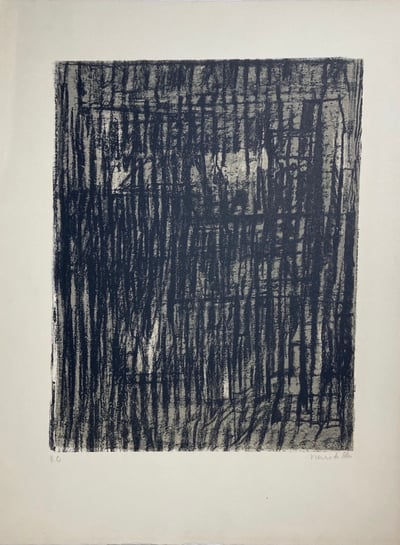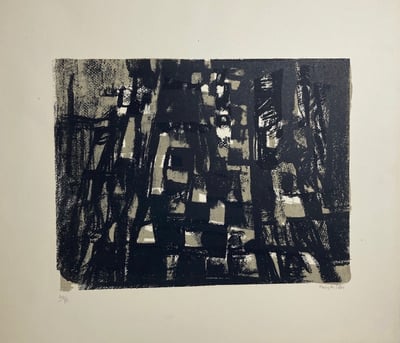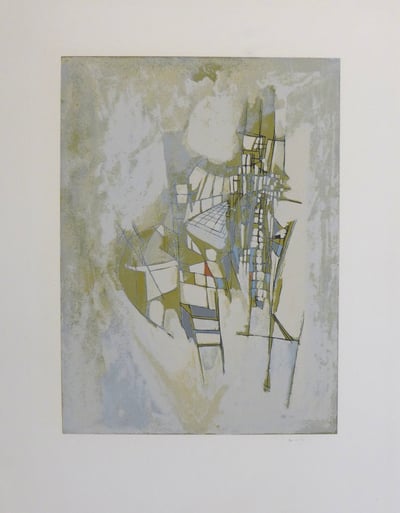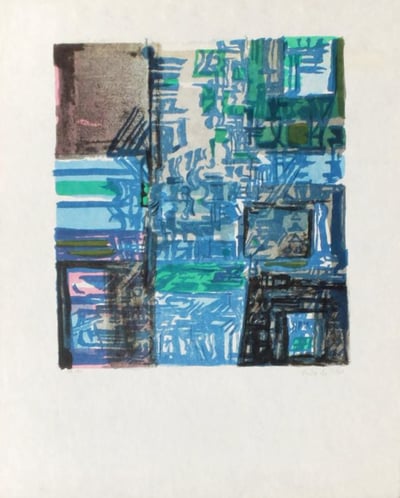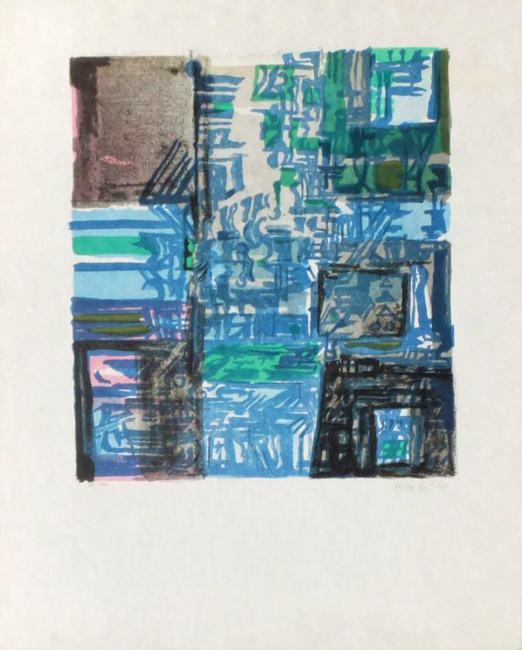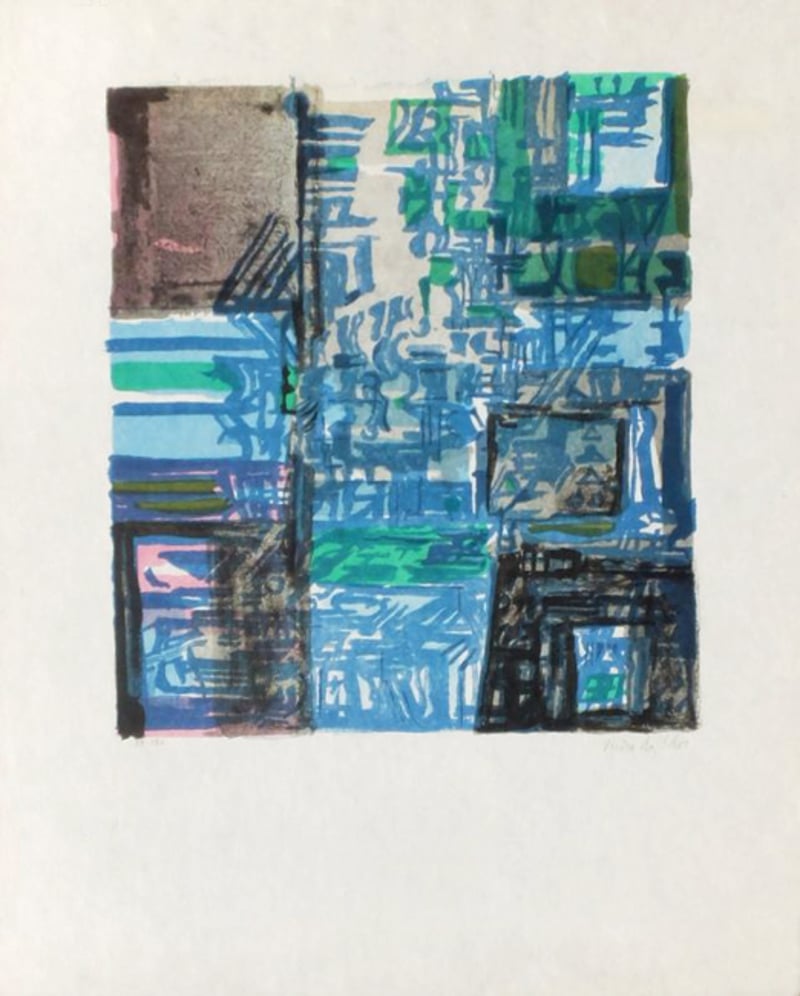
Faïence by Helena Vieira da Silva, a limited edition lithograph created in 1971, captures the artist's characteristic abstract style, combining layered colors and intricate linework. This piece, part of an edition of 150 with additional artist proofs, presents a complex composition of geometric patterns in shades of blue, green, and muted earthy tones, evoking a sense of architectural structure or a densely woven tapestry. Vieira da Silva’s work often explores spatial ambiguity and depth, encouraging viewers to navigate the interlocking forms and interpret the hidden rhythm within. With an image size of 24.5 x 27.5 cm and overall dimensions of 36.7 x 33.4 cm, Faïence invites a contemplative experience, blending abstraction with subtle hints of structure and order.
Helena Vieira da Silva (Portugal, 1908–1992) was a prominent abstract painter associated with lyrical abstraction. Her dense, labyrinthine compositions often evoke architectural spaces and shifting perspectives. Based in Paris, she fused geometric structures with poetic ambiguity, establishing herself as a major figure in 20th-century European art.
LithographLithography is a printing method based on the principle that water and oil do not mix. It can be used to print artwork or text onto paper or other suitable materials. Traditionally, an image was drawn with wax, fat, or oil onto a lithographic limestone surface or plate. Today, metal plates and other surfaces are also used in lithographic printing.
Faïence by Helena Vieira da Silva, a limited edition lithograph created in 1971, captures the artist's characteristic abstract style, combining layered colors and intricate linework. This piece, part of an edition of 150 with additional artist proofs, presents a complex composition of geometric patterns in shades of blue, green, and muted earthy tones, evoking a sense of architectural structure or a densely woven tapestry. Vieira da Silva’s work often explores spatial ambiguity and depth, encouraging viewers to navigate the interlocking forms and interpret the hidden rhythm within. With an image size of 24.5 x 27.5 cm and overall dimensions of 36.7 x 33.4 cm, Faïence invites a contemplative experience, blending abstraction with subtle hints of structure and order.
Helena Vieira da Silva (Portugal, 1908–1992) was a prominent abstract painter associated with lyrical abstraction. Her dense, labyrinthine compositions often evoke architectural spaces and shifting perspectives. Based in Paris, she fused geometric structures with poetic ambiguity, establishing herself as a major figure in 20th-century European art.
When I paint a landscape or a seascape, I’m not very sure it’s a landscape or a seascape. It’s a thought form rather than a realistic form.
- Helena Vieira da Silva
Helena Vieira da Silva (b. 1908 Portugal, d. 1992 France) was a Portuguese-French painter and one of the most prominent figures in thelyrical abstractionmovement. Her work is characterized by intricate, maze-like compositions that explore space, movement, and perception. Vieira da Silva's paintings often feature dense networks of lines and forms, creating a sense of depth and rhythm that invites viewers into a complex, almost architectural world. Influenced by Cubism and Abstract Expressionism, her art reflects a deep engagement with the dynamics of space and structure. Throughout her career, Vieira da Silva received widespread recognition, and her works are held in major collections around the world, including the Musée National d'Art Moderne in Paris and the Tate Modern in London.
Lyrical abstraction is a descriptive term characterizing a type of abstract painting closely related to Abstract Expressionism, in use from the 1940s to the present. The term can also describe two distinct but related trends in post-World War II modernist painting. This art movement originated in Paris, France, after the war, emphasizing personal expression, spontaneity, and the emotional use of color and form.