Details
Artist
Styles
Screenprint in colours. Hand-signed, numbered, and blind stamped.// One of Banksy's most iconic and instantly recognisable works, Trolleys exquisitely subverts the aesthetic conventions of prehistoric cave painting to launch a withering critique of contemporary consumer culture. Against a sepia-toned, ochre-washed background suggestive of ancient Paleolithic art, silhouetted hunter-gatherer figures push modern supermarket trolleys in a stiff, ritualistic procession across the composition. The joke is both visual and conceptual: Banksy juxtaposes humanity's earliest artistic impulses — the primitive line drawings of animals and hunters found in caves throughout France and Spain — with the detritus of contemporary consumerism, implying that modern consumer capitalism is itself a form of primitive tribalism, a survival instinct devolved into shopping. The signed version remains significantly rarer than its unsigned counterpart, having been produced in an edition of just 750 impressions. The hand-signature and edition numbering confirm this as an authorised work from Banksy's Pest Control office, executed during the height of his street art career in the early 2000s, when his transition from walls to galleries was crystallising the ironic distance between underground and institutional art. The work's deceptive simplicity masks a sophisticated commentary on how quickly consumerism colonises human behaviour, reducing citizens to solitary figures hunched over their trolleys in an endless, purposeless ritual. It remains among his most philosophically charged printed works.
Details
Artist
Styles
Screenprint in colours. Hand-signed, numbered, and blind stamped.// One of Banksy's most iconic and instantly recognisable works, Trolleys exquisitely subverts the aesthetic conventions of prehistoric cave painting to launch a withering critique of contemporary consumer culture. Against a sepia-toned, ochre-washed background suggestive of ancient Paleolithic art, silhouetted hunter-gatherer figures push modern supermarket trolleys in a stiff, ritualistic procession across the composition. The joke is both visual and conceptual: Banksy juxtaposes humanity's earliest artistic impulses — the primitive line drawings of animals and hunters found in caves throughout France and Spain — with the detritus of contemporary consumerism, implying that modern consumer capitalism is itself a form of primitive tribalism, a survival instinct devolved into shopping. The signed version remains significantly rarer than its unsigned counterpart, having been produced in an edition of just 750 impressions. The hand-signature and edition numbering confirm this as an authorised work from Banksy's Pest Control office, executed during the height of his street art career in the early 2000s, when his transition from walls to galleries was crystallising the ironic distance between underground and institutional art. The work's deceptive simplicity masks a sophisticated commentary on how quickly consumerism colonises human behaviour, reducing citizens to solitary figures hunched over their trolleys in an endless, purposeless ritual. It remains among his most philosophically charged printed works.
- Recently Added
- Price (low-high )
- Price (high-low )
- Year (low-high )
- Year (high-low )

Banksy
Barcode (unsigned), 2004
Limited Edition Print
Screen-print
EUR 25,000 - 30,000

Banksy
Trolleys, 2007
Limited Edition Print
Screen-print
Inquire For Price

Banksy
Golf Sale (Unsigned), 2003
Limited Edition Print
Screen-print
GBP 13,150

Banksy
Trolleys (Black & White Unsigned), 2007
Limited Edition Print
Screen-print
GBP 14,870

Banksy
I Fought The Law, 2004, 2004
Limited Edition Print
Screen-print
Inquire For Price

Banksy
Love Is In The Air (Unsigned), 2003
Limited Edition Print
Screen-print
Inquire For Price
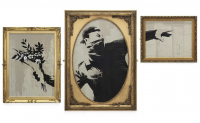
Banksy
Thrower Triptych (VIP), 2019
Limited Edition Print
Screen-print
Inquire For Price

Banksy
No Ball Games - Grey, 2009
Limited Edition Print
Screen-print
GBP 70,000 - 80,000

Banksy
Laugh Now (unsigned), 2003
Limited Edition Print
Screen-print
GBP 40,000 - 55,000

Banksy
Precision Bombing, 2000
Limited Edition Print
Mixed Media
GBP 250,000 - 280,000

Banksy
Girl With A Balloon, 2004
Limited Edition Print
Screen-print
GBP 240,000 - 270,000

Banksy
Trolley Hunters, 2007
Limited Edition Print
Screen-print
GBP 30,000 - 40,000

Banksy
Barcode, 2004
Limited Edition Print
Screen-print
GBP 70,000 - 90,000

Banksy
Sale Ends (v2), 2017
Limited Edition Print
Screen-print
GBP 28,000 - 35,000

Banksy
Four Soup Cans - Gold On Cream, 2005
Limited Edition Print
Screen-print
GBP 50,000 - 70,000

Banksy
Girl With A Balloon (unsigned), 2004
Limited Edition Print
Screen-print
GBP 90,000 - 110,000

Banksy
Heavy Weaponry, 2004
Limited Edition Print
Mixed Media
GBP 150,000 - 170,000

Banksy
Pulp Fiction (unsigned), 2004
Limited Edition Print
Screen-print
GBP 40,000 - 50,000

Banksy
Grannies, 2006
Limited Edition Print
Silkscreen
USD 32,000 - 38,000

Banksy
Morons (Sepia), 2007
Limited Edition Print
Screen-print
USD 80,000 - 95,000

Banksy
Turf War , 2003
Limited Edition Print
Screen-print
GBP 34,800

Banksy
Applause, 2006
Limited Edition Print
Screen-print
Currently Not Available
Related Artists


Related Articles

Popular, Artists - February 17, 2025
Decoding Contemporary Iconography: Uncovering Hidden Symbols in Modern Art
Uncover hidden meanings in contemporary art. Explore the symbolism in works by Ai Weiwei, Banksy, Koons, Hirst, Haring, Kusama, and Magritte. Read More


What is graffiti art?
Graffiti art refers to drawings and writings that are painted, scratched, or scribbled on walls or other surfaces, typically in public spaces. This art form ranges from small tags to elaborate wall paintings. Graffiti has been in existence since ancient times, with examples dating back to the Roman Empire, Ancient Greece, and Ancient Egypt.