Details
Artist
Styles
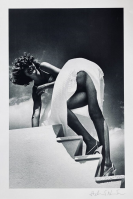
Argentic edition on argentic paper, Estate signed // Nu à la Pose by André de Dienes is a classic black-and-white nude photograph from 1960, showcasing the elegance and artistry of the human form. Captured with a refined composition, the model strikes a graceful pose, balancing delicately between two stones, her hand thoughtfully placed on her chin, exuding both poise and vulnerability. The soft lighting and smooth tonal transitions highlight the contours of the body, emphasizing the sculptural quality of the form. De Dienes’ work often merges sensuality with sophistication, and this photograph reflects his ability to render the nude in an artistic, timeless manner. The print, signed by the estate, is a testament to de Dienes' legacy in fine art photography.
Nu à la pose, 1960
form
Medium
Size
34 x 28 cm
- Inches
- Centimeters
Edition
Price
- USD
- EUR
- GBP
Details
Artist
Styles
Argentic edition on argentic paper, Estate signed // Nu à la Pose by André de Dienes is a classic black-and-white nude photograph from 1960, showcasing the elegance and artistry of the human form. Captured with a refined composition, the model strikes a graceful pose, balancing delicately between two stones, her hand thoughtfully placed on her chin, exuding both poise and vulnerability. The soft lighting and smooth tonal transitions highlight the contours of the body, emphasizing the sculptural quality of the form. De Dienes’ work often merges sensuality with sophistication, and this photograph reflects his ability to render the nude in an artistic, timeless manner. The print, signed by the estate, is a testament to de Dienes' legacy in fine art photography.
- Recently Added
- Price (low-high )
- Price (high-low )
- Year (low-high )
- Year (high-low )

Andre De Dienes
Nu Sur Le Rocher, 1960
Photography
Photograph
EUR 890

Andre De Dienes
Nu Avec Ballon, 1960
Photography
Photograph
EUR 690

Andre De Dienes
Marilyn Monroe. Au Lit, 1953/2006
Photography
Photograph
EUR 690

Andre De Dienes
Nude Bathing, 1960
Photography
Photograph
EUR 890

Andre De Dienes
Marilyn Monroe (Set Of 2), 1946
Photography
Gelatin Silver Print
USD 3,000

Andre De Dienes
Marilyn Monroe III, 1946
Photography
Gelatin Silver Print
USD 1,500

Andre De Dienes
Marilyn Monroe I, 1946
Photography
Gelatin Silver Print
USD 1,500

Andre De Dienes
Marilyn Nineteen (1945), 2006
Photography
Photograph
EUR 690

Andre De Dienes
Becoming Marilyn (1945), 2006
Photography
Photograph
EUR 690

Andre De Dienes
Nu Assise Sur Rocher, 1960
Photography
Photograph
EUR 890

Andre De Dienes
Nu Avec Fleurs, 1960
Photography
Photograph
EUR 590

Andre De Dienes
Marilyn. La Sortie De Bain. (1945), 2006
Photography
Photograph
EUR 690

Andre De Dienes
Nu à La Pose, 1960
Photography
Photograph
EUR 590

Andre De Dienes
Norma Jean In Red (Marilyn Monroe 1945), 2006
Photography
Photograph
EUR 690

Andre De Dienes
Nude On Stone Bench, 1955
Photography
Photograph
Currently Not Available
Related Artists


Related Articles

Popular, Artists - March 29, 2023
The Perky Ruminations of Nobuyoshi Araki: Highlights and Photographs from an Eros Diary
Explore the provocative world of Nobuyoshi Araki, Japan’s iconic photographer. Discover his captivating works blending eroticism, life, and cultural introspection. Read More


What is East Village Art?
In 1981, Patti Astor opened the first art gallery in New York City's East Village, helping to launch the careers of various artists and musicians. The gallery started small but quickly gained popularity, contributing to the emergence of art movements such as Neo-Expressionism and Street Art in the area. The East Village became a hub for these new artistic expressions. However, the gallery closed in 1985 due to waning interest.