What is Cubism?
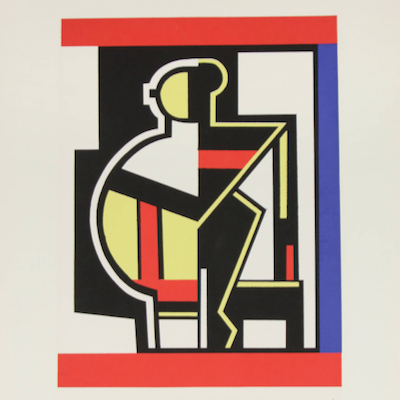
Cubism is an art movement that aimed to depict multiple perspectives of objects or figures within a single picture. Artists Georges Braque and Pablo Picasso pioneered this style around 1907. The name Cubism emerged from their use of geometric shapes and outlines that often resembled cubes, breaking objects down into abstracted forms.
- Show All
- Established
- Discoveries
ARTWORKS RELATED TO CUBISM

Pablo Picasso
Visage No. 54, 1963
Ceramics
Plate
EUR 9,800

Pablo Picasso
Bulls, 1952
Ceramics
Plate
EUR 4,800

Marc Chagall
The Bay of Angels (La Baie des Anges), 1962
Limited Edition Print
Lithograph
EUR 7,200

Pablo Picasso
Three drinkers, 1961
Limited Edition Print
Lithograph
EUR 4,800

Pablo Picasso
La plainte des femmes, 1933 / 1961
Limited Edition Print
Mixed Media
Inquire For Price

Pablo Picasso
Oursin (A.R. 268), 1955
Sculpture / Object
Plate
USD 7,000 - 9,000

Pablo Picasso
Picador (Bullfighter), 1953
Sculpture / Object
Plate
USD 7,000 - 9,000

Pablo Picasso
Peintre à Lavallière dessinant son modèle dans le Cadre de la Maison Tellier (from la Série 156), 1970
Limited Edition Print
Etching
Inquire For Price

Louise Nevelson
Sky Flower, 1977
Limited Edition Print
Collage
USD 5,000 - 6,000

Pablo Picasso
Filles entre elles, dont une avec une fleur, 1971
Limited Edition Print
Drypoint
Inquire For Price

Pablo Picasso
Mousquetaire, Abbé en Priére, Vieillard a la Chouette Et Odalisque: Méduse, Vierge ou Smple Femme?, 1970
Limited Edition Print
Etching
Inquire For Price

Pablo Picasso
60 Years of Graphic Works, 1966
Limited Edition Print
Lithograph
USD 6,900

Pablo Picasso
Le Clown, 1961
Limited Edition Print
Lithograph
USD 7,850

Pablo Picasso
Bouquet de fleurs, 1958
Limited Edition Print
Offset Print
USD 8,700
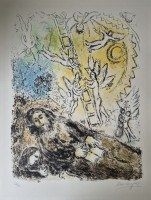
Marc Chagall
The Prophet, 1974
Limited Edition Print
Lithograph
EUR 4,800
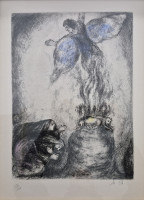
Marc Chagall
Sacrifice of Manoah, 1956
Limited Edition Print
Etching
EUR 4,200
Related Articles

Artists - March 24, 2023
Kinetic Zebras and Optical Lines: The Night Skies of Victor Vasarely's Spacetime
Dive into Victor Vasarely's world of kinetic zebras and optical lines. Explore his visionary art blending space, time, and geometric illusions. Read More


Sand consists of loose grains of material primarily made up of minerals like quartz, mica, and feldspar, as well as small fragments of rocks. Sand paintings are created by pouring colored sand into intricate designs, often for cultural rituals or special celebrations. These designs can take many days to complete and are traditionally brushed away after the ceremony, emphasizing the impermanence of the artwork.
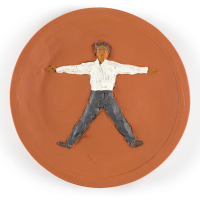
A plate is a broad, primarily flat vessel used for serving food, but it can also serve ceremonial or decorative purposes. Plates are typically circular, though they can be any shape and made from various water-resistant materials. Most plates have raised edges, either by curving upward or featuring a wider lip. Vessels without a raised edge or with a more rounded profile are often considered bowls or dishes, while very large, plate-shaped vessels might also be classified as dishes.