Details
Artist
Styles
Black and white formica cube multiple on a Plexiglas stand - Publisher: Artisst to benefit CORE - Incised signature, date and number - Inscribed To M.L.K. Jr // Untitled OP Art Cube by Richard Anuszkiewicz, created in 1968, is a sculpture exemplifying the artist's exploration of Op Art through geometric abstraction. The artwork is a black and white Formica cube measuring 10 x 10 x 10 inches, displayed on a Plexiglas stand. The cube features a dynamic, grid-like pattern that bends and distorts across its surfaces, creating an optical illusion of movement and depth. The precise alignment and manipulation of lines evoke a sense of visual tension, characteristic of Anuszkiewicz's work. This piece is not only an engaging visual object but also a tribute, as it is inscribed “To M.L.K. Jr,” reflecting a dedication to Martin Luther King Jr. and his legacy. The work was published as a multiple to benefit CORE (Congress of Racial Equality), highlighting its social and historical significance.
Untitled OP Art Cube, 1968
form
Medium
Size
25.4 x 25.4 X 25.4 cm
- Inches
- Centimeters
Edition
Price
- USD
- EUR
- GBP
Details
Artist
Styles
Black and white formica cube multiple on a Plexiglas stand - Publisher: Artisst to benefit CORE - Incised signature, date and number - Inscribed To M.L.K. Jr // Untitled OP Art Cube by Richard Anuszkiewicz, created in 1968, is a sculpture exemplifying the artist's exploration of Op Art through geometric abstraction. The artwork is a black and white Formica cube measuring 10 x 10 x 10 inches, displayed on a Plexiglas stand. The cube features a dynamic, grid-like pattern that bends and distorts across its surfaces, creating an optical illusion of movement and depth. The precise alignment and manipulation of lines evoke a sense of visual tension, characteristic of Anuszkiewicz's work. This piece is not only an engaging visual object but also a tribute, as it is inscribed “To M.L.K. Jr,” reflecting a dedication to Martin Luther King Jr. and his legacy. The work was published as a multiple to benefit CORE (Congress of Racial Equality), highlighting its social and historical significance.
- Recently Added
- Price (low-high )
- Price (high-low )
- Year (low-high )
- Year (high-low )
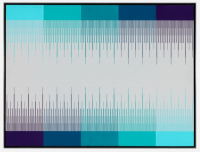
Richard Anuszkiewicz
Soft Gray, 1975
Painting
Acrylic Paint
Inquire For Price

Richard Anuszkiewicz
Untitled OP Art Cube, 1968
Sculpture / Object
Mixed Media
USD 2,990
Related Artists


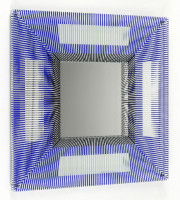
Related Articles
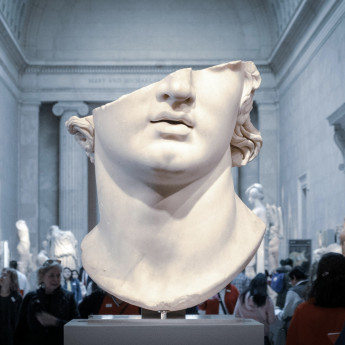
Popular, Collecting - July 23, 2025
Sculpture Care and Display: From Plinths to Pedestals in Your Home
Learn how to display and care for sculpture at home—from lighting tips to material care—so your art can truly shine in any space. Read More

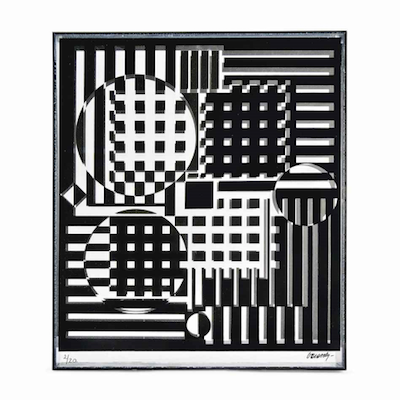
What is Op Art?
Op Art is a visual art style that uses optical illusions to create the impression of movement, vibrating patterns, flashing, or hidden images. The works are typically abstract, with many well-known pieces in black and white. The roots of Op Art can be traced back to earlier movements like Futurism, Constructivism, Dada, and Neo-Impressionism, particularly in their use of color effects and graphic design.