Details
Artist
Styles
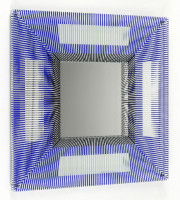
Canvas on wooden strips. // Relief Prochromatique 1 by Dario Perez-Flores, created in 2015, is a mixed media artwork that combines canvas on wooden strips to explore rhythm, color, and spatial depth. This piece features narrow, vertically aligned strips with alternating colors such as green, red, blue, black, and white. The vibrant colors and varying widths of the bands generate an optical effect, where the viewer’s perception of depth and texture shifts with movement. Perez-Flores’ composition plays with kinetic visual dynamics, inviting observers to experience how colors interact and change as they view the work from different angles, embodying the artist's fascination with optical and kinetic art.
Relief Prochromatique 1, 2015
form
Medium
Size
100 x 12 X 5 cm
- Inches
- Centimeters
Edition
Price
- USD
- EUR
- GBP
Details
Artist
Styles
Canvas on wooden strips. // Relief Prochromatique 1 by Dario Perez-Flores, created in 2015, is a mixed media artwork that combines canvas on wooden strips to explore rhythm, color, and spatial depth. This piece features narrow, vertically aligned strips with alternating colors such as green, red, blue, black, and white. The vibrant colors and varying widths of the bands generate an optical effect, where the viewer’s perception of depth and texture shifts with movement. Perez-Flores’ composition plays with kinetic visual dynamics, inviting observers to experience how colors interact and change as they view the work from different angles, embodying the artist's fascination with optical and kinetic art.
- Recently Added
- Price (low-high )
- Price (high-low )
- Year (low-high )
- Year (high-low )

Dario Perez-Flores
Prochromatique 1241, 2020
Painting
Mixed Media
EUR 27,000

Dario Perez-Flores
Prochromatique 1240, 2022
Painting
Mixed Media
EUR 27,000

Dario Perez-Flores
Prochromatique 1138, 2020
Painting
Mixed Media
EUR 27,000

Dario Perez-Flores
Prochromatique Edition 1, 2012
Painting
Mixed Media
EUR 3,500

Dario Perez-Flores
Prochromatique 1, 2010
Sculpture / Object
Mixed Media
EUR 2,700

Dario Perez-Flores
Prochromatique 2 (red, Blue, Yellow), 2012
Painting
Mixed Media
EUR 3,500

Dario Perez-Flores
Prochromatique Blanc, 2016
Painting
Mixed Media
EUR 8,500

Dario Perez-Flores
Prochromatique Bleu, 2016
Painting
Mixed Media
EUR 8,500

Dario Perez-Flores
Prochromatique Mauve, 2016
Painting
Mixed Media
EUR 8,500

Dario Perez-Flores
Prochromatique YC2, 2013
Painting
Acrylic On Canvas
EUR 3,500

Dario Perez-Flores
Relief Prochromatique 2, 2015
Painting
Mixed Media
EUR 3,500

Dario Perez-Flores
Relief Prochromatique 1, 2015
Limited Edition Print
Mixed Media
EUR 3,500

Dario Perez-Flores
Prochromatique Tryptich, 2015
Limited Edition Print
Lithograph
EUR 250

Dario Perez-Flores
Prochromatique 2, 2010
Sculpture / Object
Mixed Media
EUR 2,500

Dario Perez-Flores
Prochromatique Yc1, 2013
Painting
Mixed Media
EUR 3,500

Dario Perez-Flores
Prochromatique 3, 2010
Sculpture / Object
Acrylic Sculpture
EUR 2,500
Related Artists



Related Articles

Art Movements - April 12, 2024
The Visual Language of Geometric abstraction
Dive into the world of geometric abstraction! Discover how artists use shape, color, and space to create harmony, rhythm, and timeless expression. Read More

What is Op Art?
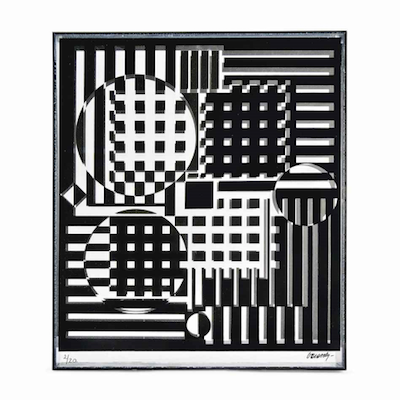
Op Art is a visual art style that uses optical illusions to create the impression of movement, vibrating patterns, flashing, or hidden images. The works are typically abstract, with many well-known pieces in black and white. The roots of Op Art can be traced back to earlier movements like Futurism, Constructivism, Dada, and Neo-Impressionism, particularly in their use of color effects and graphic design.