Details
Artist
Styles
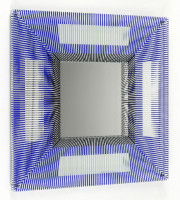
Box with 40 colored steel bars with a colored back // Prochromatique 2 by Dario Perez-Flores, created in 2010, is a mixed media artwork that incorporates vibrant color and structural depth within a framed box. The piece consists of 40 colored steel bars, each coated in different hues, arranged closely together to form a rhythmic and dynamic visual effect. The bars are set against a colored backdrop, enhancing the interplay of tones and adding dimensionality to the composition. The vertical lines of color create an optical experience, where shifting perspectives reveal variations in color intensity and depth. Perez-Flores’ work exemplifies his exploration of kinetic art principles, drawing viewers into an immersive study of color, light, and spatial perception.
Prochromatique 2, 2010
form
Medium
Size
53 x 53 X 7 cm
- Inches
- Centimeters
Edition
Price
- USD
- EUR
- GBP
Details
Artist
Styles
Box with 40 colored steel bars with a colored back // Prochromatique 2 by Dario Perez-Flores, created in 2010, is a mixed media artwork that incorporates vibrant color and structural depth within a framed box. The piece consists of 40 colored steel bars, each coated in different hues, arranged closely together to form a rhythmic and dynamic visual effect. The bars are set against a colored backdrop, enhancing the interplay of tones and adding dimensionality to the composition. The vertical lines of color create an optical experience, where shifting perspectives reveal variations in color intensity and depth. Perez-Flores’ work exemplifies his exploration of kinetic art principles, drawing viewers into an immersive study of color, light, and spatial perception.
- Recently Added
- Price (low-high )
- Price (high-low )
- Year (low-high )
- Year (high-low )

Dario Perez-Flores
Prochromatique 1241, 2020
Painting
Mixed Media
EUR 27,000

Dario Perez-Flores
Prochromatique 1240, 2022
Painting
Mixed Media
EUR 27,000

Dario Perez-Flores
Prochromatique 1138, 2020
Painting
Mixed Media
EUR 27,000

Dario Perez-Flores
Prochromatique Edition 1, 2012
Painting
Mixed Media
EUR 3,500

Dario Perez-Flores
Prochromatique 1, 2010
Sculpture / Object
Mixed Media
EUR 2,700

Dario Perez-Flores
Prochromatique 2 (red, Blue, Yellow), 2012
Painting
Mixed Media
EUR 3,500

Dario Perez-Flores
Prochromatique Blanc, 2016
Painting
Mixed Media
EUR 8,500

Dario Perez-Flores
Prochromatique Bleu, 2016
Painting
Mixed Media
EUR 8,500

Dario Perez-Flores
Prochromatique Mauve, 2016
Painting
Mixed Media
EUR 8,500

Dario Perez-Flores
Prochromatique YC2, 2013
Painting
Acrylic On Canvas
EUR 3,500

Dario Perez-Flores
Relief Prochromatique 2, 2015
Painting
Mixed Media
EUR 3,500

Dario Perez-Flores
Relief Prochromatique 1, 2015
Limited Edition Print
Mixed Media
EUR 3,500

Dario Perez-Flores
Prochromatique Tryptich, 2015
Limited Edition Print
Lithograph
EUR 250

Dario Perez-Flores
Prochromatique 2, 2010
Sculpture / Object
Mixed Media
EUR 2,500

Dario Perez-Flores
Prochromatique Yc1, 2013
Painting
Mixed Media
EUR 3,500

Dario Perez-Flores
Prochromatique 3, 2010
Sculpture / Object
Acrylic Sculpture
EUR 2,500
Related Artists



Related Articles

Artists - March 28, 2023
An Elegy to Colour, Geometry and Optics: The Visual Resonance and Forms of Julio Le Parc
Explore the vibrant world of Julio Le Parc, a pioneer in kinetic art and geometric innovation. Discover how light, form, and motion redefine viewer interaction. Read More


What is contemporary art?
Contemporary art refers to avant-garde or innovative art created in the recent past or present day. The exact starting point of contemporary art varies depending on the institution, often tied to the founding year of museums or galleries that showcase the style. Contemporary art is characterized by its focus on current ideas, diverse media, and the exploration of new concepts and techniques.