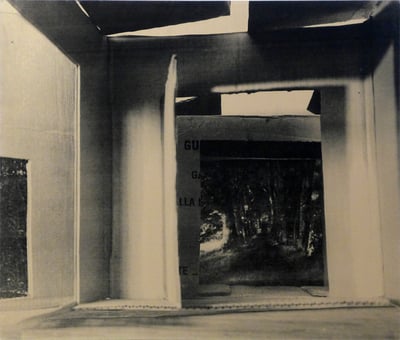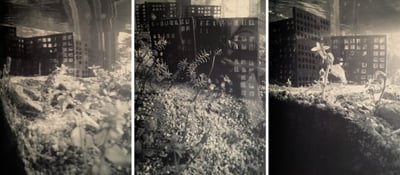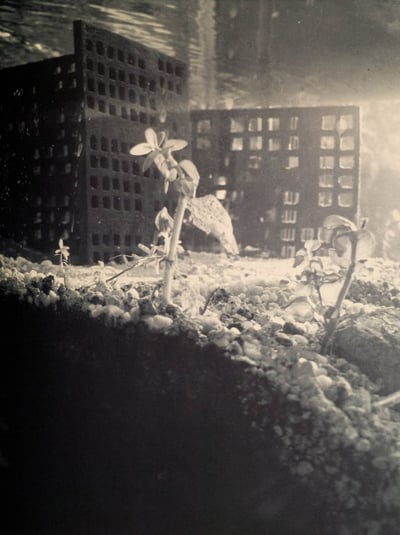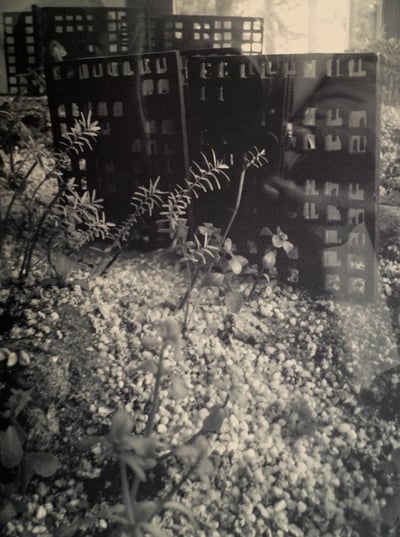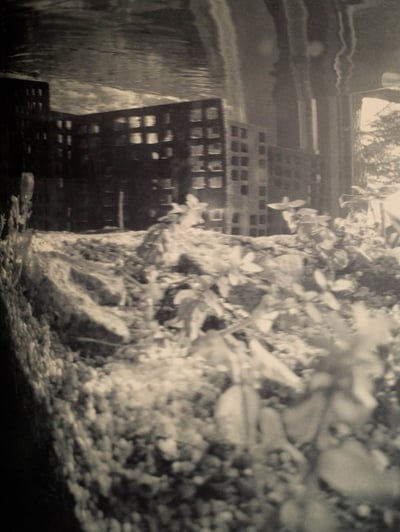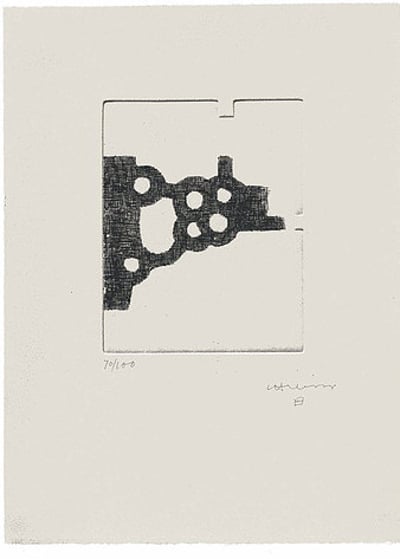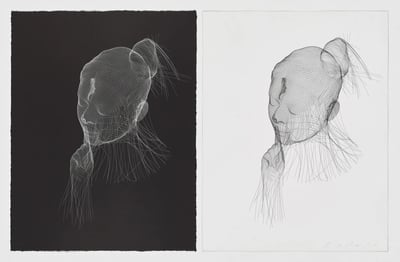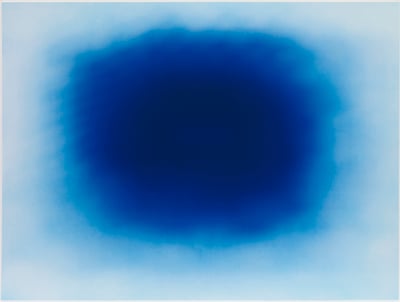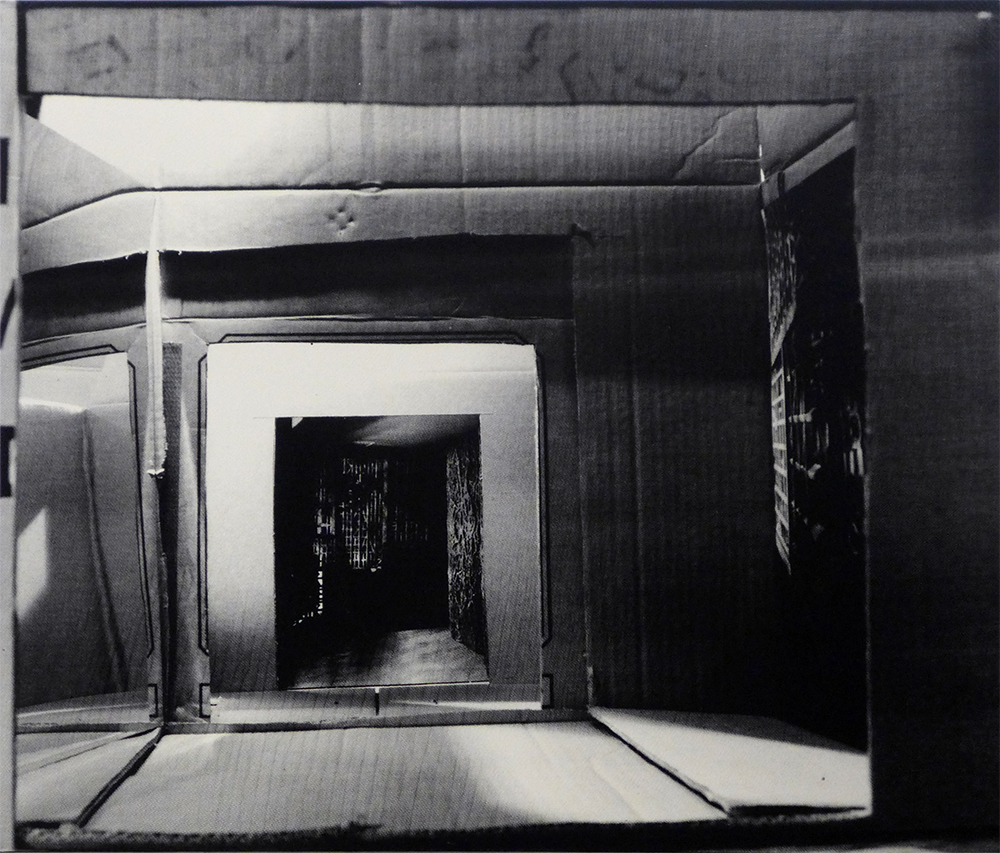
Cristina Iglesias' Habitación XI (2002) is a limited edition silkscreen print that exemplifies her exploration of space, architecture, and perception. Rendered in monochromatic tones, the image presents a disorienting, almost labyrinthine interior, created from layered cardboard or similar materials. The composition leads the viewer's gaze through a series of framed spaces, which recede into darkness, evoking a sense of infinite depth. The contrast between light and shadow enhances the geometric structure, playing with the viewer’s perception of scale and space. The work invites contemplation of architectural forms and how they shape our experience of interior and exterior environments. Iglesias’ use of silkscreen on silk adds a delicate texture to the piece, elevating the materiality and tactility of the work.
Cristina Iglesias (Spain, 1956) is a Spanish installation artist and sculptor known for creating immersive environments that blend architecture, literature, and site-specific influences. Utilizing materials like steel, water, glass, and bronze, she constructs spaces that challenge the boundaries between interior and exterior, nature and artifice. Notable works include 'Forgotten Streams' at Bloomberg Headquarters in London and 'Tres Aguas' in Toledo, Spain.
SilkscreenSilkscreen is a printmaking method that uses a screen made of silk or other mesh fabric. The screen is treated with a substance that blocks ink in certain areas, allowing ink to pass through only in the desired sections. Each color in the print requires a separate screen.
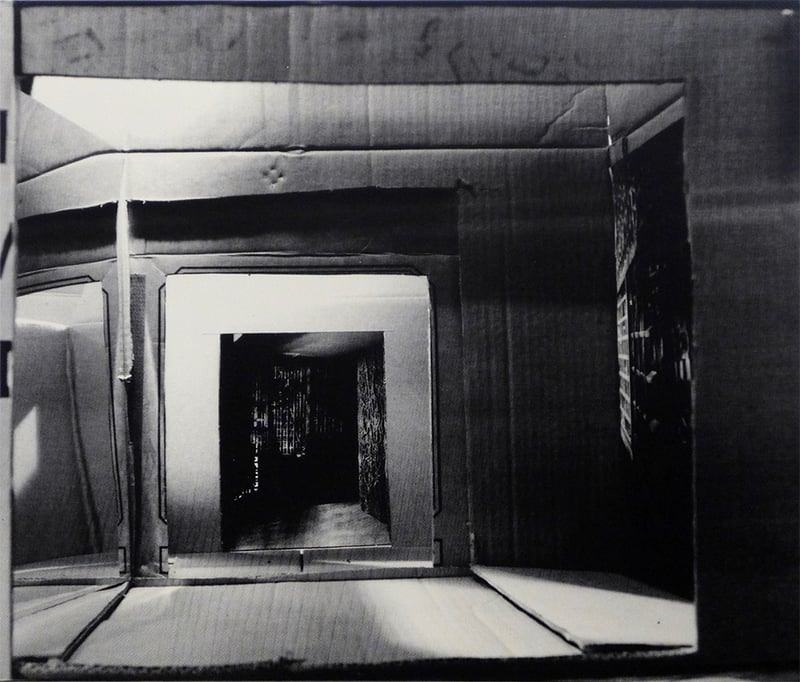
Cristina Iglesias' Habitación XI (2002) is a limited edition silkscreen print that exemplifies her exploration of space, architecture, and perception. Rendered in monochromatic tones, the image presents a disorienting, almost labyrinthine interior, created from layered cardboard or similar materials. The composition leads the viewer's gaze through a series of framed spaces, which recede into darkness, evoking a sense of infinite depth. The contrast between light and shadow enhances the geometric structure, playing with the viewer’s perception of scale and space. The work invites contemplation of architectural forms and how they shape our experience of interior and exterior environments. Iglesias’ use of silkscreen on silk adds a delicate texture to the piece, elevating the materiality and tactility of the work.
Cristina Iglesias (Spain, 1956) is a Spanish installation artist and sculptor known for creating immersive environments that blend architecture, literature, and site-specific influences. Utilizing materials like steel, water, glass, and bronze, she constructs spaces that challenge the boundaries between interior and exterior, nature and artifice. Notable works include 'Forgotten Streams' at Bloomberg Headquarters in London and 'Tres Aguas' in Toledo, Spain.
Working with memory is inevitable. Mine is often very intertwined, and it always helps me to find a thread. But there is also history, and not just the history of art.
- Cristina Iglesias
Cristina Iglesias is mainly an installation artist and sculptor based out of Spain. She works through mediums such as steel, glass, bronze, and even water. She consistently works in collaboration with architectural ideas and techniques. Many of her pieces are not only pieces of art, sometimes even suggesting a stronger message, but they are also public spaces. She has created benches for patrons in art galleries that are also a sculpture. One of Cristina Iglesias' most famous pieces of art is her underwater sculpture in Baja, California. Known for adapting to changes in maintenance, Iglesias welcomes the weathering of her sculptures. The underwater work has since become a reef and a home for wildlife of the water. Overall, she places an emphasis on environmental issues and factors that create the question of the impact our society has on out earth. (Artist website)
Minimalism is a style in music and visual arts characterized by pared-down designs and simplicity. It began in Western art after World War II, gaining prominence particularly in American visual arts. Minimalism draws heavily on aspects of modernism and is often viewed as a reaction against Abstract Expressionism, as well as a precursor to post-minimal art practices. Prominent minimalist artists include Agnes Martin, Donald Judd, Robert Morris, Frank Stella, and Dan Flavin.