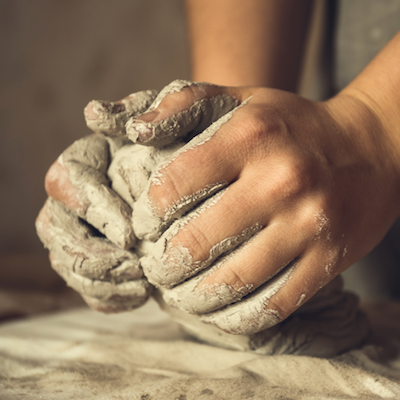
What is Clay?
Clay is earth which is made when rocks weather and finally decompose. It takes a long time for water to carry pieces of earth, creating muck. The muck is collected, cleaned, prepared by removing rocks, and refined by adding sand to make clay.
Image © DedMityay/Shutterstock- Show All
- Established
- Discoveries
ARTWORKS RELATED TO CLAY

Pablo Picasso
Dancers (pair), 1956
Sculpture / Object
Clay
Inquire For Price

Pablo Picasso
Tormented Faun’s Face, 1956
Sculpture / Object
Clay
USD 23,000 - 25,000

Pablo Picasso
Bird with tuft, 1952
Sculpture / Object
Clay
USD 3,900

Pablo Picasso
Bird under the sun, 1952
Sculpture / Object
Clay
USD 4,250

Pablo Picasso
Bird with worm, 1952
Sculpture / Object
Clay
USD 3,550

Otto Piene
Rastersonne, 2009
Ceramics
Clay
Currently Not Available


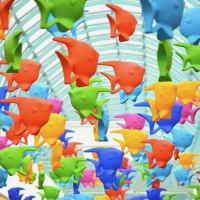
Italian art movement that comprises of artists from Italy, Belgium and France known for creation of public installations that include use of recyclable plastic to make massive animal sculptures. The artwork examines and signifies the rupture that exists between synthetic and natural worlds with plastic construction symbolizing synthetic world and the animals referring to the natural world.

Painting is the process of applying media to a surface, using a tool such as a brush. The term refers to both the action and the resulting object. Artists use many tools to paint, such as brushes, airbrushes, palette knives, sponges or fingers and hands.
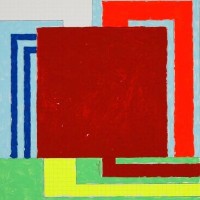
Known by Neo-Geo for short, this movement uses geometric objects and shapes to create abstract artwork as a metaphor for society. It is inspired by several different styles of 20th century art forms such as minimalism and pop-art. Starting in the 1980's, Neo-geo was in response to the industrialization and commercialization of the modern world.