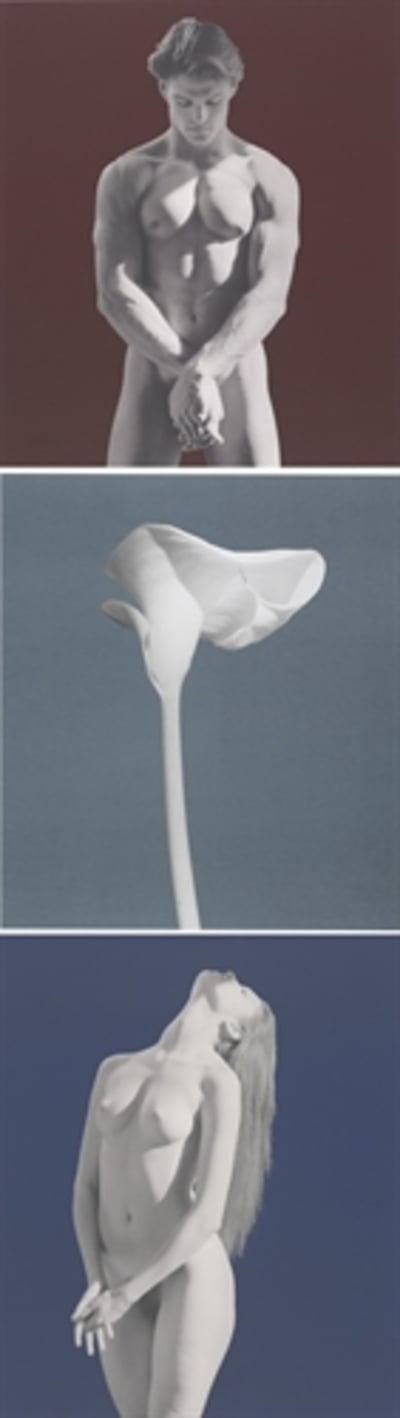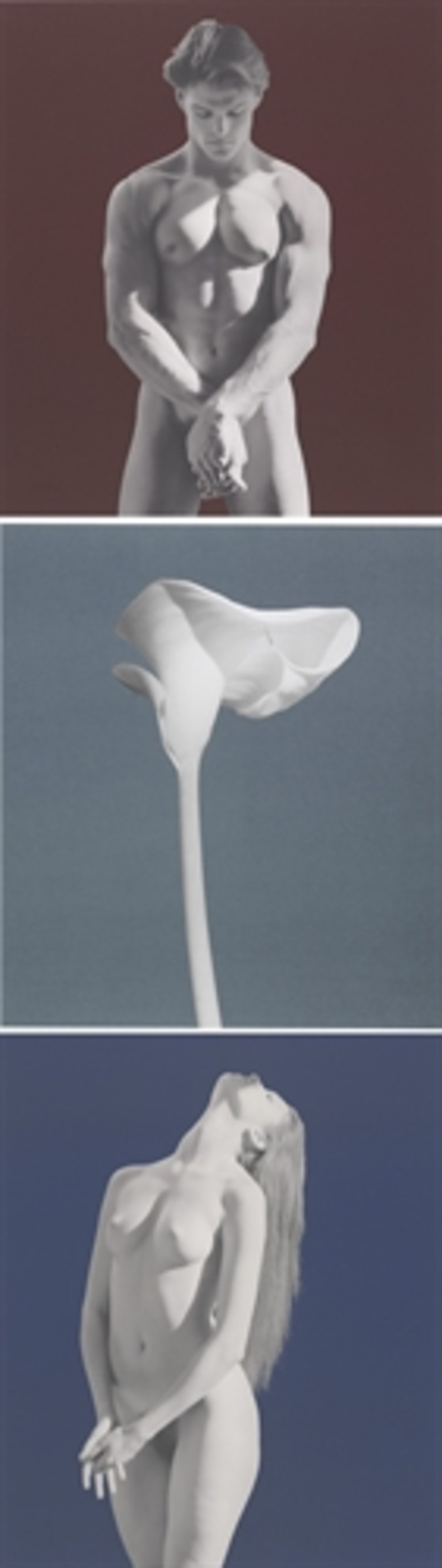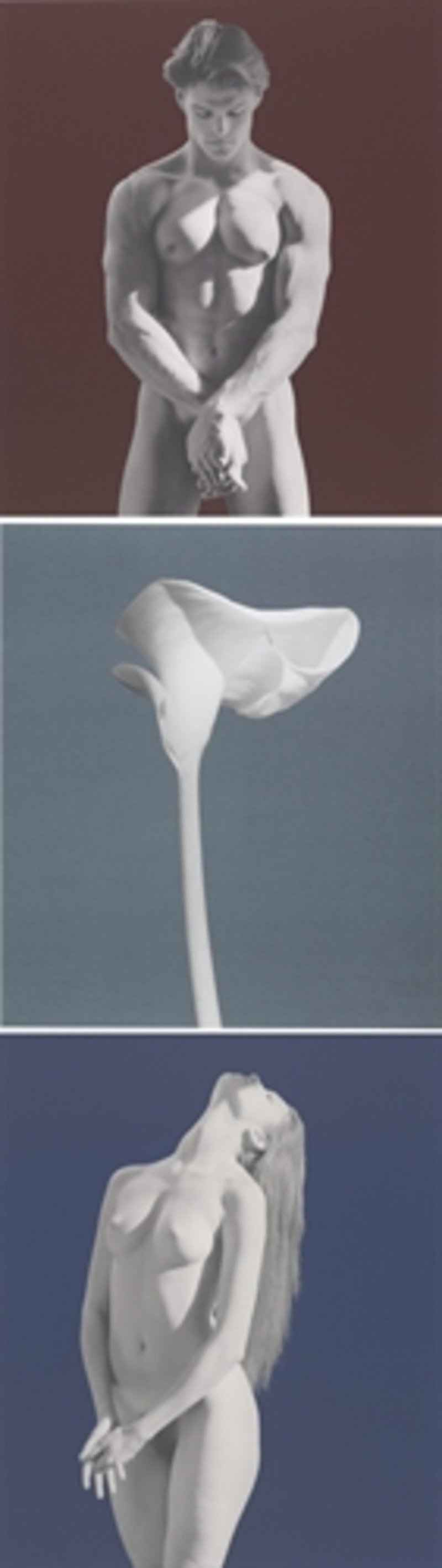
Robert Mapplethorpe’s America 3 Piece Suite (1988) is a limited edition lithograph that epitomizes his exploration of the human body, sensuality, and the natural world. The triptych features three panels: the top depicts a muscular male figure posed with hands crossed in front of his body, the middle presents an elegantly curved flower, and the bottom shows a nude female figure with her head tilted back in an evocative posture. The stark monochromatic treatment of the subjects, paired with soft backgrounds of muted colors—red, blue, and gray—creates a powerful contrast between human forms and nature. Mapplethorpe’s iconic ability to capture beauty and intimacy in minimalist compositions shines through, provoking thoughts on strength, vulnerability, and the celebration of form.
Robert Mapplethorpe (United States, 1946–1989) was a photographer renowned for his black-and-white images that explore themes of sexuality, identity, and the human form. His work includes portraits, nudes, and still lifes, often characterized by classical composition and lighting. Mapplethorpe's provocative subjects sparked significant debate on art and censorship.
LithographLithography is a printing method based on the principle that water and oil do not mix. It can be used to print artwork or text onto paper or other suitable materials. Traditionally, an image was drawn with wax, fat, or oil onto a lithographic limestone surface or plate. Today, metal plates and other surfaces are also used in lithographic printing.
Size
Inches
Centimeters
76.2 X 63.5 cm
Edition
Edition of 40
Price
20,000 – 25,000 USD
Authenticity Guaranteed
Insured Shipping
Online Since 2005
Share
●Inventory 14376
●Signed
●Comes with gallery invoice and certificate
●Any questions?
Photolithographs
Robert Mapplethorpe’s America 3 Piece Suite (1988) is a limited edition lithograph that epitomizes his exploration of the human body, sensuality, and the natural world. The triptych features three panels: the top depicts a muscular male figure posed with hands crossed in front of his body, the middle presents an elegantly curved flower, and the bottom shows a nude female figure with her head tilted back in an evocative posture. The stark monochromatic treatment of the subjects, paired with soft backgrounds of muted colors—red, blue, and gray—creates a powerful contrast between human forms and nature. Mapplethorpe’s iconic ability to capture beauty and intimacy in minimalist compositions shines through, provoking thoughts on strength, vulnerability, and the celebration of form.
Robert Mapplethorpe (United States, 1946–1989) was a photographer renowned for his black-and-white images that explore themes of sexuality, identity, and the human form. His work includes portraits, nudes, and still lifes, often characterized by classical composition and lighting. Mapplethorpe's provocative subjects sparked significant debate on art and censorship.
Beauty and the devil are the same thing.
- Robert Mapplethorpe
Robert Mapplethorpe (b. 1946 USA, d. 1989 USA) was an iconic American photographer renowned for his provocative and meticulously crafted photographs that explore themes of beauty, sexuality, and identity. Mapplethorpe's work is characterized by its formal elegance, often employing classical compositions and a refined use of light and shadow to create striking images that blur the lines between art and erotica. His subjects ranged from still lifes and floral studies to portraits and nudes, with a particular focus on the male form. Mapplethorpe's exploration of the human body, especially in his more controversial work that depicted BDSM subculture and homoerotic imagery, sparked significant debate about the boundaries of art and censorship in the 1980s. His work challenged societal norms and opened up discussions about the representation of sexuality in art. Despite the controversies, Mapplethorpe is celebrated for his technical mastery and his ability to capture the complexity and beauty of his subjects. His work has been exhibited in major museums worldwide, and he remains a pivotal figure in the history of contemporary photography. (Artist website)
Contemporary art refers to avant-garde or innovative art created in the recent past or present day. The exact starting point of contemporary art varies depending on the institution, often tied to the founding year of museums or galleries that showcase the style. Contemporary art is characterized by its focus on current ideas, diverse media, and the exploration of new concepts and techniques.