
Picadilly Station, from Urban Landscapes No. 2 (Arthur p. 117), 1979 - Screenprint in colors on Fabriano Cottone paper, signed in pencil and numbered - this is one of the 15 AP's artist's proofs), published by Parasol Press Ltd., New York, with the blindstamp of printer Edition Domberger, Stuttgart, Germany
Piccadilly Station by Richard Estes, part of the Urban Landscapes No. 2 series from 1979, is a screenprint on Fabriano Cottone paper. This work depicts an escalator descending into the depths of a subway station, showcasing Estes' signature photorealism. The view from above captures the geometric precision of the escalator steps, the glossy side panels reflecting faint silhouettes, and the rounded ceiling with fluorescent lighting casting a cold, sterile glow. The composition emphasizes depth and linear perspective, creating a sense of movement and isolation typical of urban transit environments. The detailed rendering and reflective surfaces convey a strikingly lifelike yet slightly eerie atmosphere.
Artwork Copyright © Richard EstesRichard Estes (USA, 1932) is a leading figure in Photorealism, celebrated for his meticulous urban scenes. Using photographs as references, he creates hyper-detailed paintings of reflective surfaces, storefronts, and cityscapes, capturing modern life with stunning precision.
Artwork Copyright © Richard EstesPicadilly Station, 1979
Form
Medium
Size
- Inches
- Centimeters
Edition
Price
Available works →
- Authenticity Guaranteed
- Insured Shipping
- Online Since 2005
●
●Inventory 15205
●Signed
●Comes with gallery invoice and certificate
●Sell Us a Similar Artwork. Learn more.
Picadilly Station, from Urban Landscapes No. 2 (Arthur p. 117), 1979 - Screenprint in colors on Fabriano Cottone paper, signed in pencil and numbered - this is one of the 15 AP's artist's proofs), published by Parasol Press Ltd., New York, with the blindstamp of printer Edition Domberger, Stuttgart, Germany
Piccadilly Station by Richard Estes, part of the Urban Landscapes No. 2 series from 1979, is a screenprint on Fabriano Cottone paper. This work depicts an escalator descending into the depths of a subway station, showcasing Estes' signature photorealism. The view from above captures the geometric precision of the escalator steps, the glossy side panels reflecting faint silhouettes, and the rounded ceiling with fluorescent lighting casting a cold, sterile glow. The composition emphasizes depth and linear perspective, creating a sense of movement and isolation typical of urban transit environments. The detailed rendering and reflective surfaces convey a strikingly lifelike yet slightly eerie atmosphere.
Artwork Copyright © Richard EstesRichard Estes (USA, 1932) is a leading figure in Photorealism, celebrated for his meticulous urban scenes. Using photographs as references, he creates hyper-detailed paintings of reflective surfaces, storefronts, and cityscapes, capturing modern life with stunning precision.
Artwork Copyright © Richard Estes- Recently Added
- Price (Low-High)
- Price (High-Low)
- Year (Low-High)
- Year (High-Low)
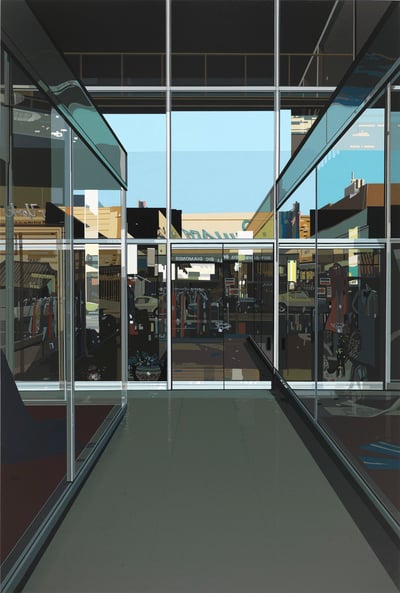
Richard Estes
Big Diamonds, 1979
Limited Edition Print
Screen-print
Currently Not Available
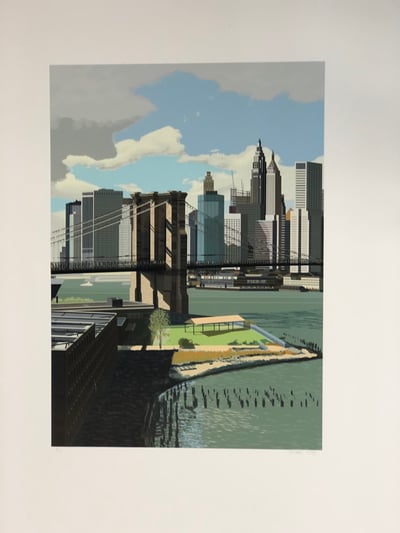
Richard Estes
East River, New York, 1989
Limited Edition Print
Serigraph
Currently Not Available
Related Artists

Related Articles
Popular, Artists, Collecting - August 20, 2026
Collecting Gerhard Richter Editions: A Guide for New and Seasoned Collectors
Learn how to collect Gerhard Richter editions: catalogue references, signatures, facsimile objects, condition, provenance and secondary-market buying.Read More


Artwork by Robert Longo
What is photorealism?
Photorealism is a genre of art or artistic movement that involves drawing, painting, and other graphic media in which the artist carefully studies a photograph and attempts to reproduce it as realistically as possible in another medium. While the term can broadly describe any artwork created in this manner, it specifically refers to a group of painters and paintings in the U.S. art movement that emerged in the late 1960s and early 1970s.


