Details
Artist
Styles
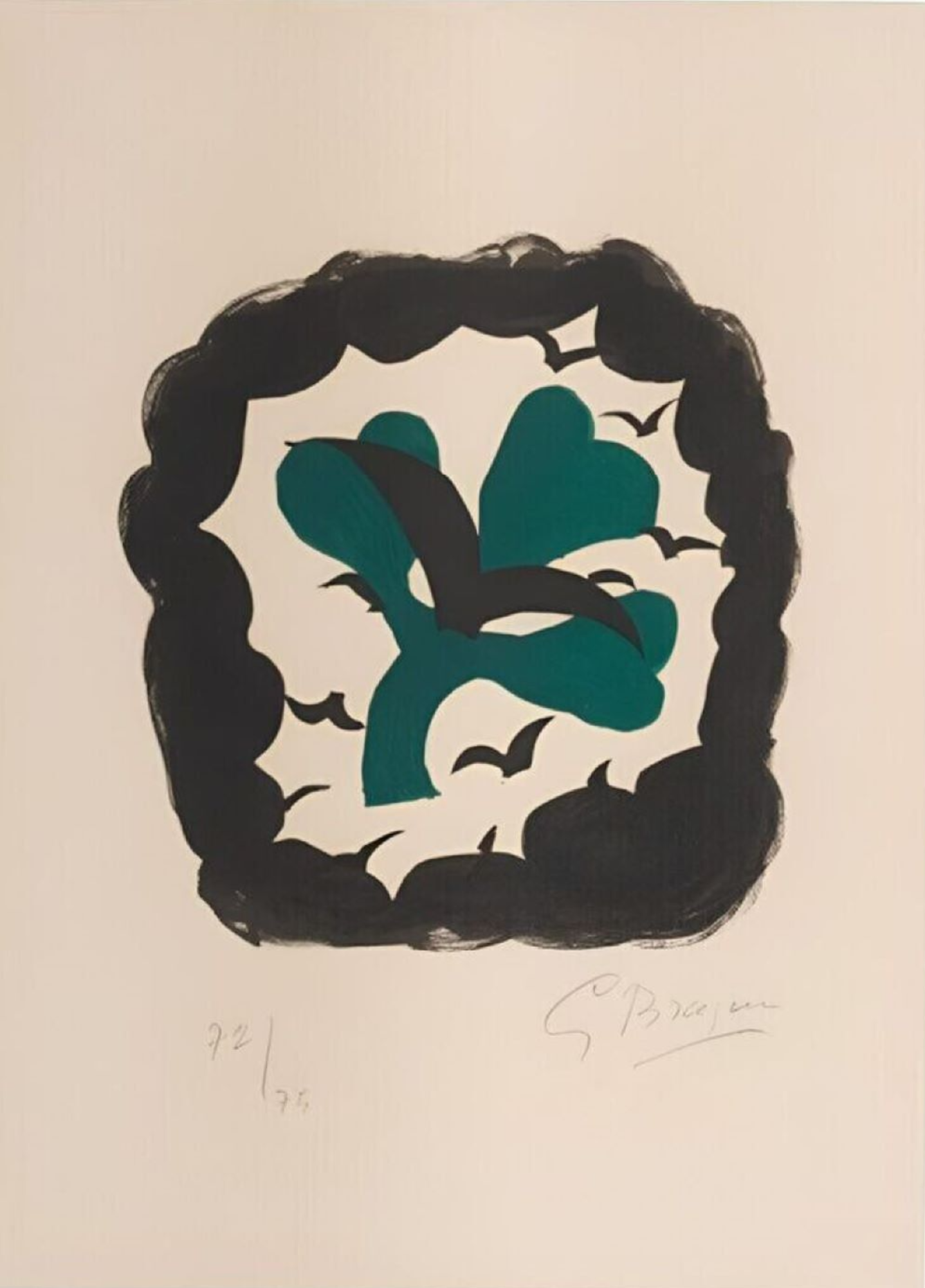
Lithograph printed in colors on Arches wove paper. Signed in pencil G Braque (lower right); numbered lower left. Le Trèfle by Georges Braque, created in 1963, is a color lithograph printed on Arches wove paper, measuring 37.9 × 28.1 cm. Part of the Lettera Amorosa suite, this print reflects Braque’s late-career fascination with poetic symbolism and organic forms. The central motif—suggestive of a cloverleaf or abstracted floral form—is surrounded by a dark, cloud-like border and scattered silhouettes of birds in flight. The composition’s simplicity and limited palette highlight Braque’s mastery of visual balance and rhythm. This work merges lyrical abstraction with a sense of quiet introspection, emblematic of his post-Cubist style.
Le Trèfle, from Lettera Amorosa, 1963
form
Medium
Size
37.9 x 28.1 cm
- Inches
- Centimeters
Edition
Range
- USD
- EUR
- GBP
Details
Artist
Styles
Lithograph printed in colors on Arches wove paper. Signed in pencil G Braque (lower right); numbered lower left. Le Trèfle by Georges Braque, created in 1963, is a color lithograph printed on Arches wove paper, measuring 37.9 × 28.1 cm. Part of the Lettera Amorosa suite, this print reflects Braque’s late-career fascination with poetic symbolism and organic forms. The central motif—suggestive of a cloverleaf or abstracted floral form—is surrounded by a dark, cloud-like border and scattered silhouettes of birds in flight. The composition’s simplicity and limited palette highlight Braque’s mastery of visual balance and rhythm. This work merges lyrical abstraction with a sense of quiet introspection, emblematic of his post-Cubist style.
- Recently Added
- Price (low-high )
- Price (high-low )
- Year (low-high )
- Year (high-low )
Georges Braque
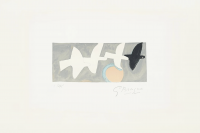
Quatre Oiseaux, 1959
Limited Edition Print
Lithograph
Inquire For Price

Georges Braque
Le Trèfle, From Lettera Amorosa, 1963
Limited Edition Print
Lithograph
USD 20,000 - 25,000

Georges Braque
Vase De Fleurs Jaunes, c. 1955
Limited Edition Print
Aquatint
EUR 1,900

Georges Braque
La Charrue (The Plow), 1960
Limited Edition Print
Lithograph
EUR 3,900

Georges Braque
Nature Morte, 1933
Limited Edition Print
Lithograph
Inquire For Price

Georges Braque
Oiseaux #178, 1962
Limited Edition Print
Lithograph
USD 4,200

Georges Braque
Les Champs M#1045, 1962
Limited Edition Print
Lithograph
USD 4,850

Georges Braque
L'envol
Limited Edition Print
Lithograph
USD 6,000

Georges Braque
Le Lierre #99 , 1955
Limited Edition Print
Etching
USD 4,200

Georges Braque
La Liberte Des Mers (Vallier 143), 1959
Limited Edition Print
Lithograph
USD 4,250

Georges Braque
La Chaise M #1046 , 1962
Limited Edition Print
Lithograph
USD 4,850

Georges Braque
Aréion (Horse), 1971
Limited Edition Print
Embossing
USD 1,150

Georges Braque
Greek Profile M. 76 – 146, 1960
Limited Edition Print
Lithograph
USD 3,650
Related Artists



Related Articles

Art Movements - June 27, 2023
Art, Rock, Paper, Scissors and Various Materials: A Brief History of the Art of Collage
Explore the rich history of collage art, from its 20th-century pioneers to contemporary innovators. Discover how diverse materials shape artistic expression. Read More

What is Cubism?
Cubism is an art movement that aimed to depict multiple perspectives of objects or figures within a single picture. Artists Georges Braque and Pablo Picasso pioneered this style around 1907. The name Cubism emerged from their use of geometric shapes and outlines that often resembled cubes, breaking objects down into abstracted forms.