Details
Artist
Styles
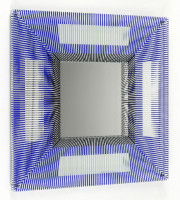
Wooden installation with Neon lamps - comes with an electrical installation. // Geneviève Claisse's Cercles Blancs, created in 1968 and revisited in 2014, is a minimalist sculptural installation that explores the interplay between form, light, and perception. This piece features a circular wooden structure illuminated by neon lamps, creating a soft, diffused glow that enhances its simplicity and elegance. The overlapping circular forms create subtle shadows and gradients, evoking a sense of depth and movement within a restrained monochromatic palette. Claisse, known for her dedication to geometric abstraction, uses this work to focus on the purity of shape and the calming effect of light. Cercles Blancs transforms its surroundings with an ambient luminosity, inviting viewers into a contemplative space that blurs the line between object and illumination.
Cercles Blancs, 1968/2014
form
Medium
Size
40 x 40 X 5 cm
- Inches
- Centimeters
Edition
Price
- USD
- EUR
- GBP
Details
Artist
Styles
Wooden installation with Neon lamps - comes with an electrical installation. // Geneviève Claisse's Cercles Blancs, created in 1968 and revisited in 2014, is a minimalist sculptural installation that explores the interplay between form, light, and perception. This piece features a circular wooden structure illuminated by neon lamps, creating a soft, diffused glow that enhances its simplicity and elegance. The overlapping circular forms create subtle shadows and gradients, evoking a sense of depth and movement within a restrained monochromatic palette. Claisse, known for her dedication to geometric abstraction, uses this work to focus on the purity of shape and the calming effect of light. Cercles Blancs transforms its surroundings with an ambient luminosity, inviting viewers into a contemplative space that blurs the line between object and illumination.
- Recently Added
- Price (low-high )
- Price (high-low )
- Year (low-high )
- Year (high-low )

Geneviève Claisse
Lignes, 2000
Painting
Acrylic On Canvas
EUR 3,500

Geneviève Claisse
Cercle Noir Et Vert, 2016
Sculpture / Object
Mixed Media
EUR 2,500

Geneviève Claisse
Cercle Rouge Et Noir, 1968-1972
Sculpture / Object
Mixed Media
EUR 2,500

Geneviève Claisse
Cercle Blanc Et Bleu, 1968-1972
Sculpture / Object
Mixed Media
EUR 2,500

Geneviève Claisse
Cercles Blancs, 1968/2014
Sculpture / Object
Mixed Media
EUR 2,000

Geneviève Claisse
Linear Sculpture, 1982
Sculpture / Object
Mixed Media
EUR 3,000

Geneviève Claisse
Cercles Jaune, 1968-2014
Sculpture / Object
Mixed Media
EUR 2,500

Geneviève Claisse
Cercles Vert, 1968-2014
Sculpture / Object
Mixed Media
EUR 2,500

Geneviève Claisse
Ryph, 1966
Sculpture / Object
Mixed Media
EUR 2,500

Geneviève Claisse
Jazz, 1966
Sculpture / Object
Mixed Media
EUR 2,500

Geneviève Claisse
Cercle Rouge, 1968-2014
Sculpture / Object
Mixed Media
Currently Not Available

Geneviève Claisse
ADN Jaune, 1972-2016
Sculpture / Object
Wood
Currently Not Available
Related Artists


Related Articles

Collecting - February 13, 2025
How to Start an Art Collection on a Budget: A Practical Guide for New Collectors
Start your art collection on a budget! Discover practical tips, affordable artworks, and expert advice to build a meaningful collection without overspending. Read More
What is Op Art?
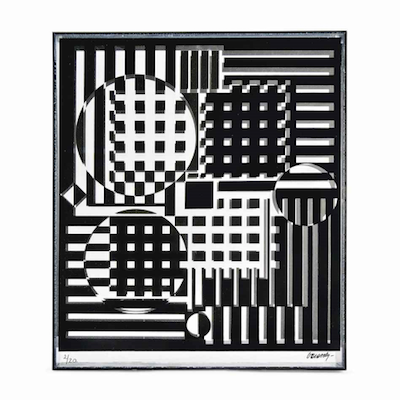
Op Art is a visual art style that uses optical illusions to create the impression of movement, vibrating patterns, flashing, or hidden images. The works are typically abstract, with many well-known pieces in black and white. The roots of Op Art can be traced back to earlier movements like Futurism, Constructivism, Dada, and Neo-Impressionism, particularly in their use of color effects and graphic design.