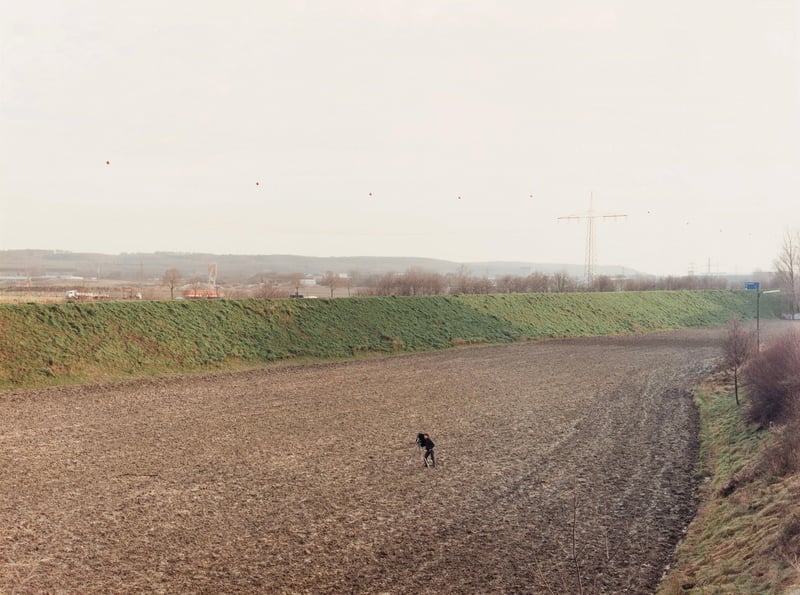
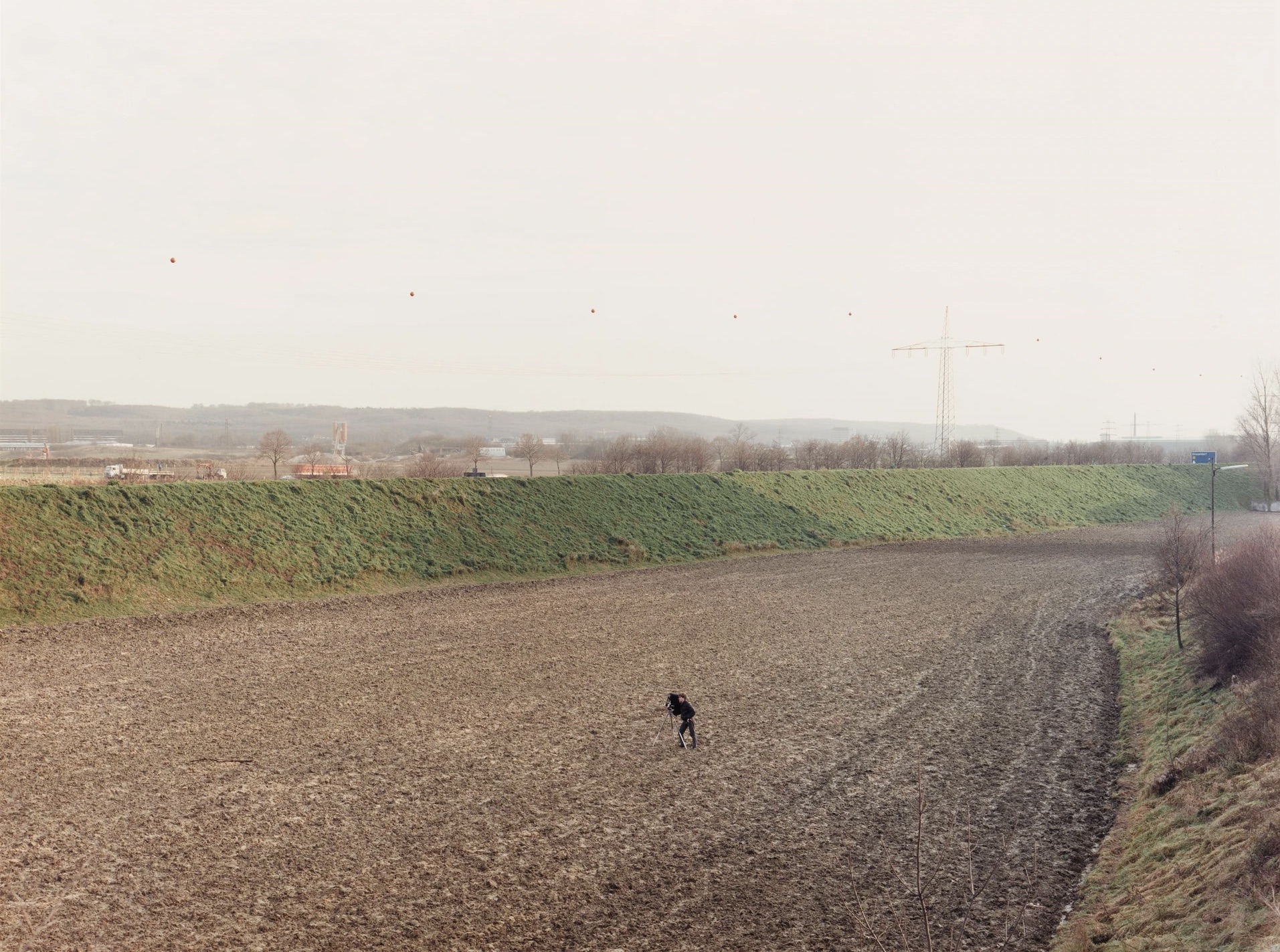
Fotograf, Düsseldorf by Andreas Gursky is a chromogenic print created in 1988, measuring 44.5 by 60 cm. Known for his expansive and meticulously composed images, Gursky captures a solitary figure with a camera tripod in a wide, barren field, edged by a grassy embankment and overlooked by power lines. The muted tones and minimalist composition emphasize scale and isolation, characteristic of Gursky’s early exploration of man’s relationship to contemporary landscapes. This image, produced shortly after his studies under Bernd and Hilla Becher, reflects their influence through its documentary style and precise framing, while also signaling Gursky's emerging interest in formal structure and spatial depth.
Artwork Copyright © Andreas GurskyAndreas Gursky (Germany, 1955) is a German photographer celebrated for his large-scale, highly detailed images that capture contemporary life and global landscapes. His work often focuses on patterns, scale, and the intersection of nature and human activity. Iconic works like 99 Cent II Diptychon explore themes of capitalism, consumerism, and modern society.
Artwork Copyright © Andreas GurskyFotograf, Düsseldorf, 1988
Form
Medium
Size
- Inches
- Centimeters
Edition
Price
- Authenticity Guaranteed
- Insured Shipping
- Online Since 2005
●Inventory 15610
●Signed
●Comes with gallery invoice and certificate
●Sell Us a Similar Artwork. Learn more.
Fotograf, Düsseldorf by Andreas Gursky is a chromogenic print created in 1988, measuring 44.5 by 60 cm. Known for his expansive and meticulously composed images, Gursky captures a solitary figure with a camera tripod in a wide, barren field, edged by a grassy embankment and overlooked by power lines. The muted tones and minimalist composition emphasize scale and isolation, characteristic of Gursky’s early exploration of man’s relationship to contemporary landscapes. This image, produced shortly after his studies under Bernd and Hilla Becher, reflects their influence through its documentary style and precise framing, while also signaling Gursky's emerging interest in formal structure and spatial depth.
Artwork Copyright © Andreas GurskyAndreas Gursky (Germany, 1955) is a German photographer celebrated for his large-scale, highly detailed images that capture contemporary life and global landscapes. His work often focuses on patterns, scale, and the intersection of nature and human activity. Iconic works like 99 Cent II Diptychon explore themes of capitalism, consumerism, and modern society.
Artwork Copyright © Andreas Gursky- Recently Added
- Price (Low-High)
- Price (High-Low)
- Year (Low-High)
- Year (High-Low)
Andreas Gursky
Fotograf, Düsseldorf, 1988
Photography
C-Print
Artwork On Hold
Related Artists


Related Articles

Art Movements - May 5, 2022
The Dusseldorf School and the birth of modern photography
Discover the Düsseldorf School of Photography, its roots in objectivity, and its legacy in modern art. Explore works by Gursky, Höfer, and the Bechers.Read More

Artwork by Bernd & Hilla Becher
What is the Dusseldorf school of photography?
The Düsseldorf School of Photography refers to a group of photographers who studied under Bernd and Hilla Becher at the Kunstakademie Düsseldorf during the 1970s. This group was known for its devotion to the black-and-white industrial images characteristic of the German tradition known as New Objectivity. The photographers focused on precise, methodical documentation of industrial structures, often using a detached and objective approach.

Andreas Gursky
Fotograf, Düsseldorf, 1988
44.5 x 60 cm


