Alexander Calder
Alexander Calder (USA, 1898–1976) revolutionized modern art with his kinetic sculptures, known as mobiles, and monumental static works, or stabiles. Combining engineering with creativity, he introduced movement and playfulness to sculpture. Calder’s innovative designs have been celebrated in major museums worldwide, cementing his legacy as a pioneer of abstract and kinetic art.
- Recently Added
- Price (Low-High)
- Price (High-Low)
- Year (Low-High)
- Year (High-Low)

Alexander Calder
Le Piège (from La Memoire Elementaire), 1976
Limited Edition Print
Lithograph
USD 9,700

Alexander Calder
Hommage á Euclide / Hommage To Euclid From La Memoire Elementaire, 1976
Limited Edition Print
Lithograph
USD 9,700

Alexander Calder
Grey Oval (Flat Mobile), 1974/1975
Limited Edition Print
Lithograph
USD 7,300

Alexander Calder
Santa Claus VIII, 1974
Limited Edition Print
Etching
USD 1,000

Alexander Calder
Santa Claus VII, 1974
Limited Edition Print
Etching
USD 1,150

Alexander Calder
Taches De Rousser (from La Memoire Elementaire), 1976
Limited Edition Print
Lithograph
USD 9,700

Alexander Calder
Trois Oignons, 1965
Limited Edition Print
Lithograph
USD 6,100

Alexander Calder
Les Vagues #21 (The Waves), 1971
Limited Edition Print
Lithograph
USD 7,500

Alexander Calder
Le Lettres, 1969
Limited Edition Print
Lithograph
USD 7,500
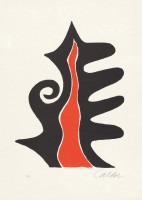
Alexander Calder
Untitled (Derriere Le Miroir #201), c. 1970
Limited Edition Print
Lithograph
Inquire For Price
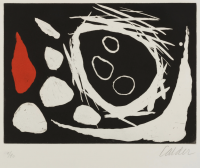
Alexander Calder
Le Crâne Dans Le Nid, 1961
Limited Edition Print
Lithograph
USD 8,350
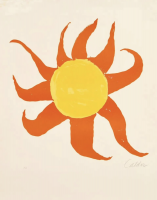
Alexander Calder
Red Sun, 1970
Limited Edition Print
Lithograph
USD 6,000 - 8,000
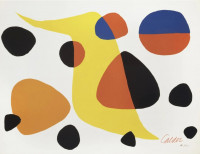
Alexander Calder
Untitled (Floating Forms), 1964
Limited Edition Print
Lithograph
Inquire For Price

Alexander Calder
Save Our Planet, Save Our Wildlife, 1971
Limited Edition Print
Offset Print
USD 2,850

Alexander Calder
Tree, 1972
Limited Edition Print
Lithograph
EUR 3,985

Alexander Calder
Untitled, 1961
Drawing / Watercolor
Mixed Media
Inquire For Price
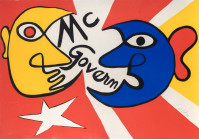
Alexander Calder
McGovern For McGovernment , 1972
Limited Edition Print
Screen-print
USD 1,850

Alexander Calder
McGovern For Government, 1974
Limited Edition Print
Lithograph
USD 1,350

Alexander Calder
Lo Oscuro Invade, 1970
Limited Edition Print
Lithograph
USD 1,650

Alexander Calder
Clown, 1976
Limited Edition Print
Lithograph
USD 5,980

Alexander Calder
Cinema On Hommage A Man Ray, 1974
Limited Edition Print
Lithograph
USD 2,600

Alexander Calder
L'Aigle, 1973
Limited Edition Print
Lithograph
USD 4,300

Alexander Calder
Fiesta, 1973
Limited Edition Print
Lithograph
Inquire For Price

Alexander Calder
Our Unfinished Revolution: Animals, 1976
Limited Edition Print
Lithograph
USD 9,700

Alexander Calder
Sala Gaspar, 1973
Limited Edition Print
Lithograph
EUR 1,350

Alexander Calder
Comètes, 1968
Limited Edition Print
Lithograph
EUR 5,500

Alexander Calder
Untitled (Red Spiral), c. 1970
Limited Edition Print
Lithograph
USD 9,700

Alexander Calder
Stone Age, ca. 1970
Limited Edition Print
Lithograph
USD 9,700

Alexander Calder
Le Point De Non Retour (from La Memoire Elementaire), 1976
Limited Edition Print
Lithograph
USD 9,700

Alexander Calder
La Pointe Du Progrès (from La Memoire Elementaire), 1976
Limited Edition Print
Lithograph
USD 9,700

Alexander Calder
Our Unfinished Revolution: Octopus/Squid, 1975-1976
Limited Edition Print
Lithograph
USD 9,700

Alexander Calder
Santa Claus X, 1974
Limited Edition Print
Etching
USD 1,700

Alexander Calder
L’albero Del Bene E Del Male, 1975
Limited Edition Print
Lithograph
EUR 4,600

Alexander Calder
Spirale Millepiedi, 1972
Limited Edition Print
Lithograph
EUR 4,850

Alexander Calder
Girandola, 1972
Limited Edition Print
Lithograph
EUR 4,850

Alexander Calder
Alphabet Et Serpent, 1968
Limited Edition Print
Lithograph
USD 6,000

Alexander Calder
Les Deux Lues, 1974
Limited Edition Print
Lithograph
USD 7,500

Alexander Calder
Tabouret Et Trois Pieds, 1969
Limited Edition Print
Lithograph
USD 6,100

Alexander Calder
Santa Claus VI, 1974
Limited Edition Print
Etching
USD 1,000

Alexander Calder
Santa Claus IV, 1974
Limited Edition Print
Etching
USD 1,000

Alexander Calder
Santa Claus III, 1974
Limited Edition Print
Etching
Inquire For Price

Alexander Calder
Santa Claus I, 1974
Limited Edition Print
Etching
USD 1,000
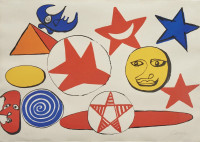
Alexander Calder
L Etoile Rouge, 1976
Limited Edition Print
Lithograph
Currently Not Available
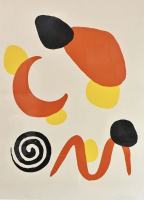
Alexander Calder
Red Moon And Swirl, 1965
Limited Edition Print
Lithograph
Currently Not Available

Alexander Calder
Untitled (from The La Memoire Elementaire), 1976
Limited Edition Print
Lithograph
Currently Not Available

Alexander Calder
Papouse, 1969
Limited Edition Print
Lithograph
Currently Not Available

Alexander Calder
Untitled (Spirals And Forms), 1965
Limited Edition Print
Lithograph
Currently Not Available
Related Artists


Related Articles

Collecting - March 21, 2024
Building a Thematic Art Collection: A Guide to Curated Artistry
Learn to build a thematic art collection that reflects your passion. Discover tips for curating, acquiring, and displaying art with a personal touch. Read More

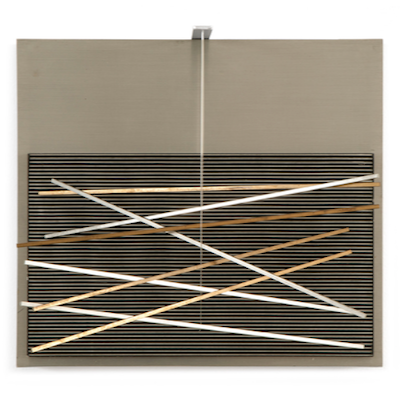
What is kinetic art?
Kinetic art is an international movement that emerged in the 1920s and gained prominence in the 1960s, referring to art that involves both apparent and real motion. It encompasses any medium that includes movement, either relying on actual motion for its effect or being perceived as moving by the viewer. Early examples include canvas paintings designed to create optical illusions of movement. Today, kinetic art often refers to three-dimensional figures and sculptures, such as those operated by machines or those that move naturally. The movement covers a variety of styles and techniques that frequently overlap.