Details
Artist
Styles
Lithograph in colors on Japon nacre - Printed by Arts-Litho, Paris and published by Éditions de la Différence, Paris. // Alexander Calder’s Untitled (from the La mémoire élémentaire portfolio) (1976) is a lithograph that epitomizes his fascination with geometric forms and vibrant colors. This print features a dynamic arrangement of pyramidal shapes in bold hues of red, blue, yellow, black, and orange, creating a lively interplay of color and form. Set against a neutral background, the pyramids appear to be scattered across the composition, each shape outlined with thick black lines that add definition and contrast. Calder’s use of primary and secondary colors emphasizes his modernist approach, transforming simple geometric elements into a visually stimulating and playful composition. Printed on Japon nacré paper by Arts-Litho in Paris and published by Éditions de la Différence, this piece demonstrates Calder’s ability to translate the movement and balance seen in his sculptures into two-dimensional works, preserving the sense of motion and spontaneity.
Hommage á Euclide / Hommage to Euclid from La Memoire Elementaire, 1976
form
Medium
Size
51.4 x 71.8 cm
- Inches
- Centimeters
Edition
Price
- USD
- EUR
- GBP
Details
Artist
Styles
Lithograph in colors on Japon nacre - Printed by Arts-Litho, Paris and published by Éditions de la Différence, Paris. // Alexander Calder’s Untitled (from the La mémoire élémentaire portfolio) (1976) is a lithograph that epitomizes his fascination with geometric forms and vibrant colors. This print features a dynamic arrangement of pyramidal shapes in bold hues of red, blue, yellow, black, and orange, creating a lively interplay of color and form. Set against a neutral background, the pyramids appear to be scattered across the composition, each shape outlined with thick black lines that add definition and contrast. Calder’s use of primary and secondary colors emphasizes his modernist approach, transforming simple geometric elements into a visually stimulating and playful composition. Printed on Japon nacré paper by Arts-Litho in Paris and published by Éditions de la Différence, this piece demonstrates Calder’s ability to translate the movement and balance seen in his sculptures into two-dimensional works, preserving the sense of motion and spontaneity.
- Recently Added
- Price (low-high )
- Price (high-low )
- Year (low-high )
- Year (high-low )

Alexander Calder
Le Piège (from La Memoire Elementaire), 1976
Limited Edition Print
Lithograph
USD 9,600

Alexander Calder
Hommage á Euclide / Hommage To Euclid From La Memoire Elementaire, 1976
Limited Edition Print
Lithograph
USD 9,600

Alexander Calder
Grey Oval (Flat Mobile), 1974/1975
Limited Edition Print
Lithograph
USD 7,300

Alexander Calder
Santa Claus VIII, 1974
Limited Edition Print
Etching
USD 1,000

Alexander Calder
Santa Claus VII, 1974
Limited Edition Print
Etching
USD 1,150

Alexander Calder
Taches De Rousser (from La Memoire Elementaire), 1976
Limited Edition Print
Lithograph
USD 9,600

Alexander Calder
Trois Oignons, 1965
Limited Edition Print
Lithograph
USD 6,100

Alexander Calder
Les Vagues #21 (The Waves), 1971
Limited Edition Print
Lithograph
USD 7,500

Alexander Calder
Le Lettres, 1969
Limited Edition Print
Lithograph
USD 7,500

Alexander Calder
Young Artists, 1971
Limited Edition Print
Lithograph
Inquire For Price
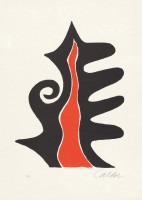
Alexander Calder
Untitled (Derriere Le Miroir #201), c. 1970
Limited Edition Print
Lithograph
Inquire For Price
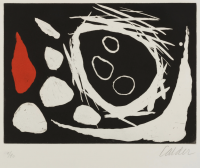
Alexander Calder
Le Crâne Dans Le Nid, 1961
Limited Edition Print
Lithograph
USD 8,350
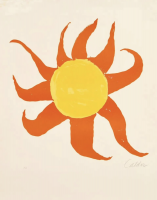
Alexander Calder
Red Sun, 1970
Limited Edition Print
Lithograph
USD 6,000 - 8,000
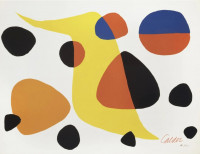
Alexander Calder
Untitled (Floating Forms), 1964
Limited Edition Print
Lithograph
USD 9,000 - 12,000

Alexander Calder
Save Our Planet, Save Our Wildlife, 1971
Limited Edition Print
Offset Print
USD 2,850

Alexander Calder
Tree, 1972
Limited Edition Print
Lithograph
EUR 3,985

Alexander Calder
Untitled, 1961
Drawing / Watercolor
Mixed Media
Inquire For Price
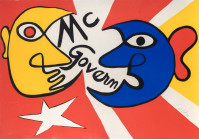
Alexander Calder
McGovern For McGovernment , 1972
Limited Edition Print
Screen-print
USD 1,850

Alexander Calder
McGovern For Government, 1974
Limited Edition Print
Lithograph
USD 1,350

Alexander Calder
Lo Oscuro Invade, 1970
Limited Edition Print
Lithograph
USD 1,650

Alexander Calder
Clown, 1976
Limited Edition Print
Lithograph
USD 5,980

Alexander Calder
Cinema On Hommage A Man Ray, 1974
Limited Edition Print
Lithograph
USD 2,600

Alexander Calder
L'Aigle, 1973
Limited Edition Print
Lithograph
USD 4,300

Alexander Calder
Our Unfinished Revolution: Animals, 1976
Limited Edition Print
Lithograph
USD 9,600

Alexander Calder
Sala Gaspar, 1973
Limited Edition Print
Lithograph
EUR 1,350

Alexander Calder
Comètes, 1968
Limited Edition Print
Lithograph
EUR 5,500

Alexander Calder
Untitled (Red Spiral), c. 1970
Limited Edition Print
Lithograph
USD 9,600

Alexander Calder
Stone Age, ca. 1970
Limited Edition Print
Lithograph
USD 9,600

Alexander Calder
Le Point De Non Retour (from La Memoire Elementaire), 1976
Limited Edition Print
Lithograph
USD 9,600

Alexander Calder
La Pointe Du Progrès (from La Memoire Elementaire), 1976
Limited Edition Print
Lithograph
USD 9,600

Alexander Calder
Our Unfinished Revolution: Octopus/Squid, 1975-1976
Limited Edition Print
Lithograph
USD 9,600

Alexander Calder
Santa Claus X, 1974
Limited Edition Print
Etching
USD 1,700

Alexander Calder
L’albero Del Bene E Del Male, 1975
Limited Edition Print
Lithograph
EUR 4,600

Alexander Calder
Spirale Millepiedi, 1972
Limited Edition Print
Lithograph
EUR 4,850

Alexander Calder
Girandola, 1972
Limited Edition Print
Lithograph
EUR 4,850

Alexander Calder
Alphabet Et Serpent, 1968
Limited Edition Print
Lithograph
USD 6,000

Alexander Calder
Les Deux Lues, 1974
Limited Edition Print
Lithograph
USD 7,500

Alexander Calder
Tabouret Et Trois Pieds, 1969
Limited Edition Print
Lithograph
USD 6,100

Alexander Calder
Santa Claus VI, 1974
Limited Edition Print
Etching
USD 1,000

Alexander Calder
Santa Claus IV, 1974
Limited Edition Print
Etching
USD 1,000

Alexander Calder
Santa Claus III, 1974
Limited Edition Print
Etching
Inquire For Price

Alexander Calder
Santa Claus I, 1974
Limited Edition Print
Etching
USD 1,000
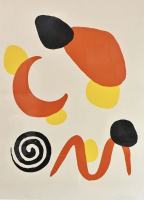
Alexander Calder
Red Moon And Swirl, 1965
Limited Edition Print
Lithograph
Currently Not Available

Alexander Calder
Papouse, 1969
Limited Edition Print
Lithograph
Currently Not Available

Alexander Calder
Untitled (Spirals And Forms), 1965
Limited Edition Print
Lithograph
Currently Not Available
Related Artists


Related Articles

Artists - March 29, 2023
Mobiles, Maquettes, Tulips and Butterflies: Alexander Calder, the Architect of XX Century Sculpture
Discover Alexander Calder's transformative impact on 20th-century sculpture. Explore his iconic mobiles, dynamic art, and inventive approach to creativity. Read More


What is abstract art?
Abstract art uses form, shape, line, and color to create a visual experience without attempting to represent external reality. The composition exists independently of the world's visual references, focusing on expressing ideas and emotions through non-representational means.