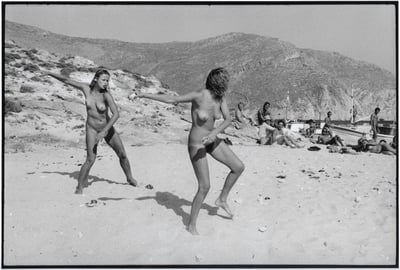
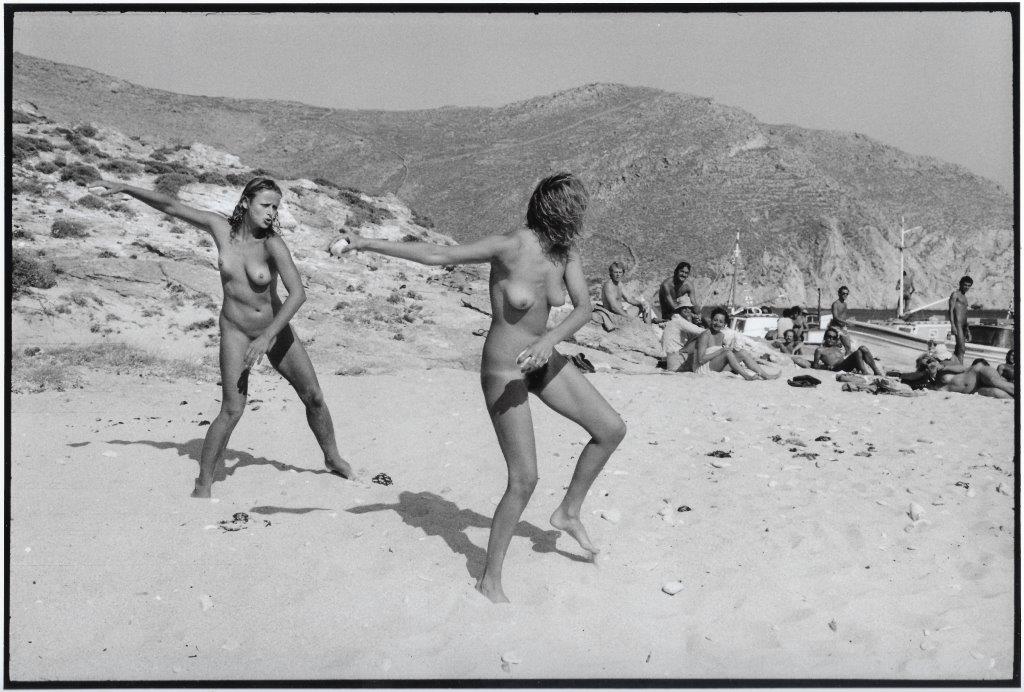
Freed was vacationing in Greece in 1975 when he spotted these Stone Throwing Athletes
Leonard Freed's Mykonos Athletes (1975) is a compelling black-and-white photograph that captures an impromptu scene of athleticism and freedom on a beach in Mykonos, Greece. The archival print presents two nude figures engaged in a dynamic stone-throwing stance, embodying both grace and strength against a backdrop of rugged hills and scattered beachgoers. The photograph’s composition balances movement with stillness, as the active figures stand in contrast to the relaxed onlookers in the background. Freed’s choice of black-and-white enhances the timeless quality of the image, highlighting the contrasts in light and shadow, and imbuing the scene with a raw, unfiltered authenticity. This work reflects Freed’s keen eye for spontaneous human expression and the natural beauty of the Greek landscape.
Leonard Freed (USA, 1929–2006) was a documentary photographer and longtime Magnum Photos member. Best known for his poignant black-and-white images, he captured pivotal moments of the Civil Rights Movement, everyday life in post-war Europe, and themes of justice and humanity.
Archival PrintAn archival print refers to a fine art reproduction of museum quality, created using the highest quality materials and methods. These prints are produced on the finest papers and with inks specifically designed to resist color fading over time. Drawings and paintings are reproduced using a fine art printer with exceptionally high resolution, ensuring longevity and preservation of the artwork.
Freed was vacationing in Greece in 1975 when he spotted these Stone Throwing Athletes
Leonard Freed's Mykonos Athletes (1975) is a compelling black-and-white photograph that captures an impromptu scene of athleticism and freedom on a beach in Mykonos, Greece. The archival print presents two nude figures engaged in a dynamic stone-throwing stance, embodying both grace and strength against a backdrop of rugged hills and scattered beachgoers. The photograph’s composition balances movement with stillness, as the active figures stand in contrast to the relaxed onlookers in the background. Freed’s choice of black-and-white enhances the timeless quality of the image, highlighting the contrasts in light and shadow, and imbuing the scene with a raw, unfiltered authenticity. This work reflects Freed’s keen eye for spontaneous human expression and the natural beauty of the Greek landscape.
Leonard Freed (USA, 1929–2006) was a documentary photographer and longtime Magnum Photos member. Best known for his poignant black-and-white images, he captured pivotal moments of the Civil Rights Movement, everyday life in post-war Europe, and themes of justice and humanity.
Photographing is an emotional thing, a graceful thing. Photography allows me to wander with a purpose.
- Leonard Freed
Leonard Freed moved past his initial ambition to be a painter when he discovered his natural talent for photography, and has since gone on to be one of the most renowned photographers in the world. Freed was born into a working-class Jewish family, and his earliest photographs would capture the essence of his Jewish roots through portraits of everyday life and German society.
Throughout his career, Freed has captured some of the most important social and political events from across the globe, and his most famous work is perhaps his collection of photographs taken during the American Civil Rights movement. He has captured wars, protests and the work of the NYPD throughout his years behind the camera, and his focus on social and racial issues led to him becoming a member of Magnum - the international photographic cooperative created to capture events from across the globe - in 1972.
More than 15 Books have been published on Freed’s Photographs and his Photographs are in the Permanent Collections of the Tate, MET, MoMA, Smithsonian, Alinari, Folkwang, Getty, High Museum, Jewish Museum of Amsterdam, Stedelijk, Jewish Museum Berlin and others.
Postmodernism is an art movement that emerged as a reaction against authority and traditional boundaries, seeking to blur the lines between art and everyday life. It aimed to bridge the gap between the cultural elite and the general public by embracing eclectic mixtures of earlier conventions and styles. Postmodernist art often challenges established norms and celebrates diversity, irony, and pastiche, making it a movement that reflects the complexities of contemporary culture.