
What is Epreuvre d’Artist?
Épreuve d'Artist refers to the artist's proofs in a limited edition of prints. These are a small number of prints reserved by the artist for personal use and are typically marked with the abbreviation E.A. (épreuve d'artist) or AP (artist's proof). Artist’s proofs are usually identical to the regular edition but are often considered more valuable due to their limited quantity.
Born in the print workshop
The artist's proof grew out of a practical workshop routine. Before an edition is printed, trial impressions are pulled from the plate, stone or screen so the artist can judge how the image is developing. Ink density, registration, paper tone and the bite of a line all reveal themselves only on paper, so these working proofs are annotated, corrected and pulled again until the artist is satisfied. The impression that finally meets approval is inscribed with the printer's traditional formula and becomes the benchmark every sheet in the edition must match.
"Bon à tirer" — good to pull.
Traditional printer's mark of approval
Artist's proofs in the modern sense are something slightly different: finished impressions, identical to the numbered edition, that the artist reserves outside it. The custom took hold in nineteenth-century France, when publishers commonly paid artists partly in impressions of their own prints. Those sheets were marked épreuve d'artiste — E.A. — to distinguish them from the commercial run. The habit stuck, and today virtually every serious print publisher sets aside a small group of proofs for the artist alongside the numbered edition.
Reading the margin
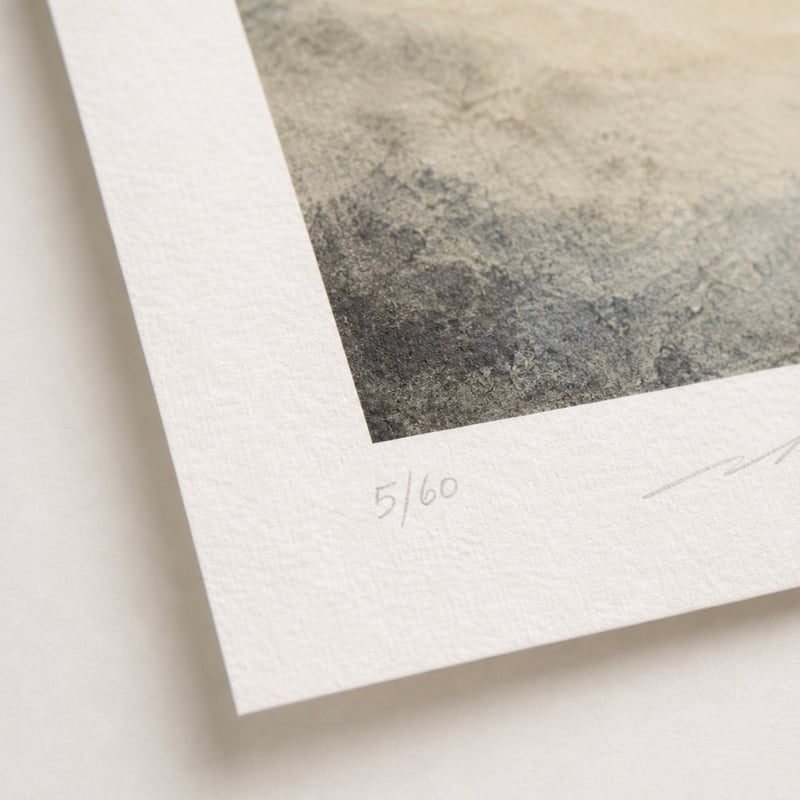
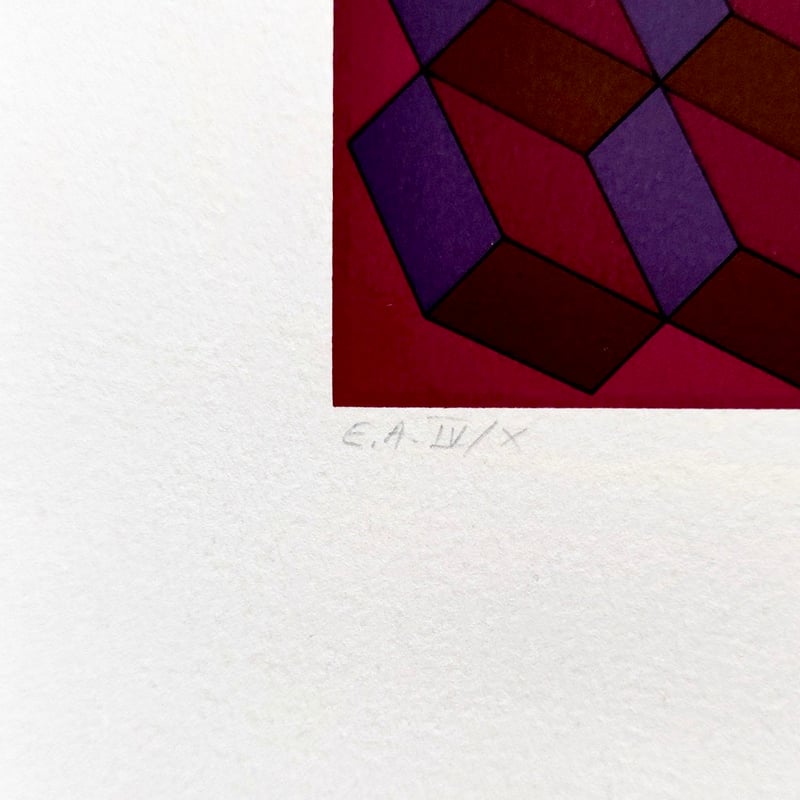
The lower margin of a print carries its paperwork. A numbered impression reads as a fraction — 12/50, say — while artist's proofs are inscribed E.A. or A.P., often with their own count, either as a fraction (E.A. 3/10) or in Roman numerals (A.P. IV/X) to keep them visibly separate from the edition proper. Convention holds the number of artist's proofs to roughly ten percent of the edition size, though practice varies by artist and era.
Other inscriptions live in the same margin and are easily confused with E.A. H.C. (hors commerce, "not for sale") marks proofs reserved for the publisher's use, exhibitions or archives. P.P. denotes printer's proofs given to the workshop. B.A.T. identifies that single approved benchmark impression, usually retained by the printer. Each category is legitimate, but each is distinct — and knowing which is which is the first skill of the print collector.
Are artist's proofs worth more?
Often, yes — but for reasons worth understanding. In most cases an E.A. is printed from the same matrix, on the same paper, in the same session as the numbered edition; the image itself is no better. The premium rests on scarcity and association. There may be only five or ten artist's proofs against an edition of a hundred, and because these sheets belonged to the artist, ones that surface from an artist's studio or estate carry an appealing provenance. That said, the market prices the image first: a sought-after subject in fine condition will outperform designation every time, and an E.A. of a weak image is still a weak image.
Earlier trial and working proofs are a separate case. Where they show visible differences from the final state — an unfinished passage, a colour variant, handwritten annotations — they can interest collectors precisely because they document the creative process, and specialist collectors sometimes pay strongly for them.
What to check before you buy
First, the arithmetic. Ask how many proofs exist in total — E.A., H.C., P.P. — alongside the numbered edition. Reputable publishers keep proofs to around ten percent of the edition; a print with fifty "proofs" behind an edition of sixty has effectively had its edition quietly enlarged, and its scarcity claim weakens accordingly.
Second, the paperwork. Where a catalogue raisonné exists for the artist's prints, it will normally record the edition size and the number of proofs; check that the sheet in front of you fits the published facts. Documentation from the original publisher and a clear ownership history matter as much for a proof as for any numbered impression.
Third, the sheet itself. Inscriptions should be in pencil, in the margin, and consistent with the artist's known hand. Examine the margins closely — trimming destroys value, and the E.A. inscription is only meaningful on an untrimmed, unrestored sheet. Finally, remember that E.A. is a designation, not a guarantee: signature, condition and provenance still do the heavy lifting.
Related Terms

An artist proof traditionally refers to a print impression taken during the printing process to evaluate the current state of the artwork as the artist works on the plate. These proofs often show incomplete images and are sometimes called trial impressions or working proofs. However, in modern practice, an artist proof typically refers to an impression of the finished work that is identical to the numbered edition copies but is set aside for the artist's personal use. Artist proofs are usually marked A.P. and may be considered more valuable by collectors due to their limited availability.
Attribute can function as both a noun and a verb. As a noun, it refers to an object, symbol, or animal commonly associated with a specific person, often used in art to identify figures, such as a lion with St. Mark. As a verb, it means to assign a work of art to a particular artist, usually based on stylistic analysis or other evidence, such as attributing a painting to an artist based on its technique and composition.
Authenticity refers to the qualities that define an original artwork as genuine, created by the artist under the original circumstances. A reproduction lacks authenticity because it was not made by the original artist and does not share the same context or creation process. The authenticity of an original artwork can be questioned when reproductions exist, which can diminish its value. Authenticity is often established through provenance, expert analysis, and documentation, ensuring the artwork's originality.
Related Articles

Can't find your Answer?
Thank you! Your question has been sent — we'll get back to you shortly.
